This shouldn't have any user visible effect, but makes the logic within
the linker implementation more explicit.

Note how DWARF debug info sections were retained even if enabling a link
with PDB info only; that behaviour is preserved.
[RFC](https://discourse.llvm.org/t/rfc-add-build-id-flag-to-lld-link/74661)

Before, lld-link only generate the debug directory containing guid when
generating PDB with the hash of PDB content.

With this change, lld-link can generate the debug directory when only
`/build-id` is given:
1. If generating PDB, `/build-id` is ignored. Same behaviour as before.
2. Not generating PDB, using hash of the binary.
   - Not under MinGW, the debug directory is still in `.rdata` section.
   - Under MinGW, place the debug directory into new `.buildid` section.
The MinGW mode (enabled with the flag -lldmingw) does allow duplicate
weak symbols. A test in
compiler-rt/test/profile/Windows/coverage-weak-lld.cpp does currently
enable the -lldmingw flag in an MSVC context, in order to deal with
duplicate weak symbols.

Add a new, separate, lld specific flag for enabling this. In MinGW mode,
this is enabled by default, otherwise it is disabled.

This allows making the MinGW mode more restrictive in adding libpaths
from the surrounding environment; in MinGW mode, all libpaths are passed
explicitly by the compiler driver to the linker, which is attempted in
https://reviews.llvm.org/D144084.
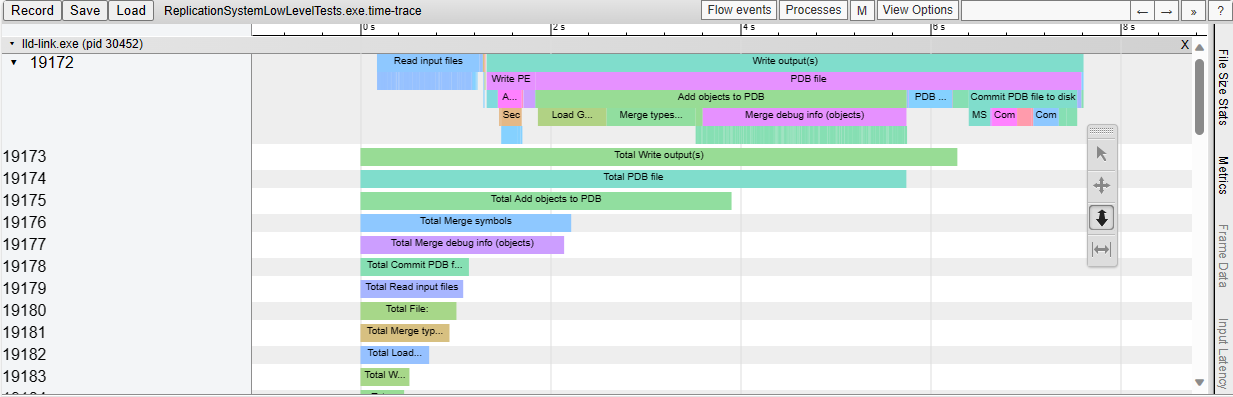
This adds support for generating Chrome-tracing .json profile traces in
the LLD COFF driver.
Also add the necessary time scopes, so that the profile trace shows in
great detail which tasks are executed.
As an example, this is what we see when linking a Unreal Engine
executable:
C++20 will automatically generate an operator== with reversed operand
order, which is ambiguous with the written operator== when one argument
is marked const and the other isn't.
While working on adding more implicit search paths to the
lld COFF driver, it was helpful to have a way to print all
the search paths, both for debugging and for testing without
having to create very complicated test cases.

This is a simple arg that just prints the search paths and exits.

Related to the efforts in #63827

Differential Revision: https://reviews.llvm.org/D155047
This patch added /dwodir to lld/COFF which is equivalent to lld/ELF
option -plugin-opt=dwo_dir=. This option tells LTO backend to create
dwo directory and files and all dwo files will be in it. Otherwise all
dwarf sections will be embeded into image even if -gsplit-dwarf is
specified when using LTO.

Reviewed By: MaskRay

Differential Revision: https://reviews.llvm.org/D154070
The corresponding class definition was removed by:

  commit 502d4ce2e4921cc38ef1226ae093e594d900fe46
  Author: Reid Kleckner <rnk@google.com>
  Date:   Mon Jun 26 15:39:52 2017 +0000
MSVC link.exe allows overriding exports on the cmd-line with exports seen in OBJ directives. The typical case is what is described in #62329.
Before this patch, trying to override an export with `/export` or `/def` would generate a duplicate warning. This patches tries to replicate the MSVC behavior. A second override on the cmd-line would still generate the warning.
There's still a case which we don't cover: MSVC link.exe is able to demangle an exported OBJ directive function, and match it with a unmangled export function in a .def file. In the meanwhile, one can use the mangled export in the .def to cover that case.
This fixes#62329
Differential revision: https://reviews.llvm.org/D149611
This adds very minimal support for ARM64EC/ARM64X targets,
just enough for interesting test cases. Next patches in the
series extend llvm-objdump and llvm-readobj to provide
better tests. Those will also be useful for testing further
ARM64EC LLD support.

Differential Revision: https://reviews.llvm.org/D149086
Currently, the --thinlto-prefix-replace="oldpath;newpath" option is used during
distributed ThinLTO thin links to specify the mapping of the input bitcode object
files' directory tree (oldpath) to the directory tree (newpath) used for both:

1) the output files of the thin link itself (the .thinlto.bc index files and the
optional .imports files)
2) the specified object file paths written to the response file given in the
--thinlto-index-only=${response} option, which is used by the final native
link and must match the paths of the native object files that will be
produced by ThinLTO backend compiles.
This patch expands the --thinlto-prefix-replace option to allow a separate directory
tree mapping to be specified for the object file paths written to the response file
(number 2 above). This is important to support builds and build systems where the
same output directory may not be written by multiple build actions (e.g. the thin link
and the ThinLTO backend compiles).

The new format is: --thinlto-prefix-replace="origpath;outpath[;objpath]"

This replaces the origpath directory tree of the thin link input files with
outpath when writing the thin link index and imports outputs (number 1
above). If objpath is specified it replaces origpath of the input files with
objpath when writing the response file (number 2 above), otherwise it
falls back to the old behavior of using outpath for this as well.

Reviewed By: tejohnson, MaskRay

Differential Revision: https://reviews.llvm.org/D144596
Allow controlling the CodeGenOpt::Level independent of the LTO
optimization level in LLD via new options for the COFF, ELF, MachO, and
wasm frontends to lld. Most are spelled as --lto-CGO[0-3], but COFF is
spelled as -opt:lldltocgo=[0-3].

See D57422 for discussion surrounding the issue of how to set the CG opt
level. The ultimate goal is to let each function control its CG opt
level, but until then the current default means it is impossible to
specify a CG opt level lower than 2 while using LTO. This option gives
the user a means to control it for as long as it is not handled on a
per-function basis.

Reviewed By: MaskRay, #lld-macho, int3

Differential Revision: https://reviews.llvm.org/D141970
This reverts commit 7370ff624d217b0f8f7512ca5b651a9b8095a411.
(and 47fb8ae2f9a4075de05433ef24f459b6befd1730).

This commit broke the symbol type in import libraries generated
for mingw autoexported symbols, when the source files were built
with LTO. I'll commit a testcase that showcases this issue after
the revert.
Like D134013, but for COFF and Mach-O.

Also expand the ELF test a bit. I at first didn't realize that `getValue()` for
`-mllvm -foo=bar` would return `-foo=bar` instead of just `bar`, and so
I wrote the test to check if we indeed get this wrong. We don't, but
having the test for it seems nice, so I'm including it.

Differential Revision: https://reviews.llvm.org/D137971
This patch adds a new flag vfsoverlay similar to clang’s
ivfsoverlay flag. This is helpful when compiling on case
sensitive file systems when cross compiling to Windows.
Particularly when compiling third party code containing
\#pragma comment(“linker”, “/defaultlib:...”) which
can’t be easily changed.

Differential Revision: https://reviews.llvm.org/D125800
Mostly for compatibility reasons with link.exe this flag
makes sure we don't write a implib - not even when /implib
is also passed, that's how link.exe works.

Reviewed By: mstorsjo

Differential Revision: https://reviews.llvm.org/D123591
This removes options for performing LTO with the legacy pass
manager in LLD. Options that explicitly enable the new pass manager
are retained as no-ops.

Differential Revision: https://reviews.llvm.org/D123219
D46245 added support for this in llvm-libtool, but while lld-link can
also create .lib files from .def files it didn't support aliases.

I compared the Inputs/library.def test against the output from
llvm-libtool and it matches, except for the fact that lld-link reorders
functions for some reason.

I have also verified that this fixes a bug I was running into while
trying to compile .def files to .lib files in MinGW-w64 (using lld-link
instead of llvm-libtool).

Differential Revision: https://reviews.llvm.org/D113365
It's not used for anything yet, but we now accept `/pdbpagesize:4096`
(the default behavior) and we give arguably more useful diagnostics
for other values.

It's plumbed through to the MSF layer, so just uncommenting out
the bit in DriverUtils.cpp that rejects args other than 4096 is enough
to try other values.

Differential Revision: https://reviews.llvm.org/D112871
If multiple /manifestdependency: flags are passed, they are
naively deduped, but after that each of them should have an
effect, instead of just the last one.

Also, /manifestdependency: flags are allowed in .drectve sections
(from `#pragma comment(linker, ...`). To make the interaction between
/manifestdependency: flags enabling manifest by default but
/manifest:no overriding this work, add an explict ManifestKind::Default
state to represent no explicit /manifest flag being passed.
To make /manifestdependency: flags from input file .drectve sections
work with /manifest:embed, delay embedded manifest emission until
after input files have been read.

Differential Revision: https://reviews.llvm.org/D108628
When enable CSPGO for ThinLTO, there are profile cfg mismatch warnings that will cause lld-link errors (with /WX)
due to source changes (e.g. `#if` code runs for profile generation but not for profile use)
To disable it we have to use an internal "/mllvm:-no-pgo-warn-mismatch" option.
In contrast clang uses option ”-Wno-backend-plugin“ to avoid such warnings and gcc has an explicit "-Wno-coverage-mismatch" option.

Add "lto-pgo-warn-mismatch" option to lld COFF/ELF to help turn on/off the profile mismatch warnings explicitly when build with ThinLTO and CSPGO.

Differential Revision: https://reviews.llvm.org/D104431
When enable CSPGO for ThinLTO, there are profile cfg mismatch warnings that will cause lld-link errors (with /WX).
To disable it we have to use an internal "/mllvm:-no-pgo-warn-mismatch" option.
In contrast clang uses option ”-Wno-backend-plugin“ to avoid such warnings and gcc has an explicit "-Wno-coverage-mismatch" option.

Add this "lto-pgo-warn-mismatch" option to lld to help turn on/off the profile mismatch warnings explicitly when build with ThinLTO and CSPGO.

Reviewed By: tejohnson

Differential Revision: https://reviews.llvm.org/D104431
If linking directly against a DLL without an import library, the
DLL export symbols might not contain stdcall decorations.

If we have an undefined symbol with decoration, and we happen to have
a matching undecorated symbol (which either is lazy and can be loaded,
or already defined), then alias it against that instead.

This matches what's done in reverse, when we have a def file
declaring to export a symbol without decoration, but we only have
a defined decorated symbol. In that case we do a fuzzy match
(SymbolTable::findMangle). This case is more straightforward; if we
have a decorated undefined symbol, just strip the decoration and look
for the corresponding undecorated symbol name.

Add warnings and options for either silencing the warning or disabling
the whole feature, corresponding to how ld.bfd does it.

(This feature works for any symbol decoration mismatch, not only when
linking against a DLL directly; ld.bfd also tolerates it anywhere,
and also fixes up mismatches in the other direction, like
SymbolTable::findMangle, for any symbol, not only exports. But in
practice, at least for lld, it would primarily end up used for linking
against DLLs.)

Differential Revision: https://reviews.llvm.org/D104532
This is more or less a port of rL329598 (D45275) to the COFF linker.
Since there were already LTO-related settings under -opt:, I added
them there instead of new flags.

Differential Revision: https://reviews.llvm.org/D90624
As they can be set independently after D88802, we can get rid of a bit
of extra code - simplifying the logic here before adding more
complication to it later.

Differential Revision: https://reviews.llvm.org/D88803
The MinGW driver has separate options for OS and subsystem version.
Having this available in lld-link allows the MinGW driver to both match
GNU ld better and simplifies the code for merging two (potentially
mismatching) arguments into one.

Differential Revision: https://reviews.llvm.org/D88802
Previously this flag was just ignored. If set, set the
IMAGE_DLL_CHARACTERISTICS_NO_SEH bit, regardless of the normal safeSEH
machinery.

In mingw configurations, the safeSEH bit might not be set in e.g. object
files built from handwritten assembly, making it impossible to use the
normal safeseh flag. As mingw setups don't generally use SEH on 32 bit
x86 at all, it should be fine to set that flag bit though - hook up
the existing GNU ld flag for controlling that.

Differential Revision: https://reviews.llvm.org/D84701
Allow disabling either the full auto import feature, or just
forbidding the cases that require runtime fixups.

As long as all auto imported variables are referenced from separate
.refptr$<name> sections, we can alias them on top of the IAT entries
and don't actually need any runtime fixups via pseudo relocations.
LLVM generates references to variables in .refptr stubs, if it
isn't known that the variable for sure is defined in the same object
module. Runtime pseudo relocs are needed if the addresses of auto
imported variables are used in constant initializers though.

Fixing up runtime pseudo relocations requires the use of
VirtualProtect (which is disallowed in WinStore/UWP apps) or
VirtualProtectFromApp. To allow any risk of ambiguity, allow
rejecting cases that would require this at the linker stage.

This adds support for the --disable-runtime-pseudo-reloc and
--disable-auto-import options in the MinGW driver (matching GNU ld.bfd)
with corresponding lld private options in the COFF driver.

Differential Revision: https://reviews.llvm.org/D78923
Summary:
/PDBSTREAM:<name>=<file> adds the contents of <file> to stream <name> in the resulting PDB.

This allows native uses with workflows that (for example) add srcsrv streams to PDB files to provide a location for the build's source files.

Results should be equivalent to linking with lld-link, then running Microsoft's pdbstr tool with the command line:
pdbstr.exe -w -p:<PDB LOCATION> -s:<name> -i:<file>
except in cases where the named stream overlaps with a default named stream, such as "/names". In those cases, the added stream will be overridden, making the /pdbstream option a no-op.

Reviewers: thakis, rnk

Reviewed By: thakis

Differential Revision: https://reviews.llvm.org/D77310
Before this patch, it wasn't possible to extend the ThinLTO threads to all SMT/CMT threads in the system. Only one thread per core was allowed, instructed by usage of llvm::heavyweight_hardware_concurrency() in the ThinLTO code. Any number passed to the LLD flag /opt:lldltojobs=..., or any other ThinLTO-specific flag, was previously interpreted in the context of llvm::heavyweight_hardware_concurrency(), which means SMT disabled.

One can now say in LLD:
/opt:lldltojobs=0 -- Use one std::thread / hardware core in the system (no SMT). Default value if flag not specified.
/opt:lldltojobs=N -- Limit usage to N threads, regardless of usage of heavyweight_hardware_concurrency().
/opt:lldltojobs=all -- Use all hardware threads in the system. Equivalent to /opt:lldltojobs=$(nproc) on Linux and /opt:lldltojobs=%NUMBER_OF_PROCESSORS% on Windows. When an affinity mask is set for the process, threads will be created only for the cores selected by the mask.

When N > number-of-hardware-threads-in-the-system, the threads in the thread pool will be dispatched equally on all CPU sockets (tested only on Windows).
When N <= number-of-hardware-threads-on-a-CPU-socket, the threads will remain on the CPU socket where the process started (only on Windows).

Differential Revision: https://reviews.llvm.org/D75153
Added support for /map and /map:[filepath].
The output was derived from Microsoft's Link.exe output when using that same option.
Note that /MAPINFO support was not added.

The previous implementation of MapFile.cpp/.h was meant for /lldmap, and was renamed to LLDMapFile.cpp/.h
MapFile.cpp/.h is now for /MAP
However, a small fix was added to lldmap, replacing a std::sort with std::stable_sort to enforce reproducibility.

Differential Revision: https://reviews.llvm.org/D70557
Recent versions of Microsoft's dumpbin tool cannot handle such PE files.
LLVM tools and GNU tools can, and use this to encode long section names
like ".debug_info", which is commonly used for DWARF. Don't do this in
mingw mode or when -debug:dwarf is passed, since the user probably wants
long section names for DWARF sections.

PR43754

Reviewers: ruiu, mstorsjo

Differential Revision: https://reviews.llvm.org/D69594
As we now have code that parses the dwarf info for variable locations,
we can use that instead of relying on the higher level Symbolizer library,
reducing the previous two different dwarf codepaths into one.

Differential Revision: https://reviews.llvm.org/D69198

llvm-svn: 375391
