During testing of https://github.com/llvm/llvm-project/pull/96202 we
found that when clang set to DWARF v2 was used to build the test file,
lldb could not tell that the unsigned enum type was in fact unsigned. So
it defaulted to signed and printed the wrong value.
The reason for this is that DWARFv2 does not include DW_AT_type in
DW_TAG_enumeration_type. This was added in DWARF v3:
"The enumeration type entry may also have a DW_AT_type attribute which
refers to the underlying data type used to implement the enumeration.
In C or C++, the underlying type will be the appropriate integral type
determined by the compiler from the properties of the enumeration
literal values."
I noticed that gcc does emit this attribute for DWARF v2 but not when
strict DWARF is requested (more details in
https://gcc.gnu.org/bugzilla/show_bug.cgi?id=16063#c7).
This patch changes to clang to do the same. This will improve the
experience of anyone using tools that can understand the attribute but
for whatever reason are stuck building binaries containing v2 only.
You can see a current clang/gcc comparison here:
https://godbolt.org/z/eG9Kc9WGfhttps://reviews.llvm.org/D42734 added the original code that emitted
this for >= v3 only.
In the RISC-V architecture, multiple vendor-specific Control and Status
Registers (CSRs) share the same encoding. However, the existing lookup
function, which currently returns only a single result, falls short.
During disassembly, it consistently returns the first CSR encountered,
which may not be the correct CSR for the subtarget.

To address this issue, we modify the function definition to return a
range of results. These results can then be iterated upon to identify
the CSR that best fits the subtarget’s feature requirements. The
behavior of this new definition is controlled by a variable named
`ReturnRange`, which defaults to `false`.

Specifically, this patch introduces support for emitting a new lookup
function for the primary key. This function returns a pair of iterators
pointing to the first and last values, providing a comprehensive range
of values that satisfy the query
This extension consists of 8 additional 16-bit compressed forms for
existing standard load/store opcodes.

These opcodes are found in some RISC-V microcontrollers from WCH /
Nanjing Qinheng Microelectronics.

As discussed in the Discourse forums, this uses incompatible extension
and opcode names vs the vendor binary toolchain. The chosen names
instead follow the conventions for other vendor extensions listed on the
"riscv-non-isa" project.
Add a spec for yet-to-be-implemented metadata to allow the backend to
fully handle atomicrmw lowering. This is the base of an alternative
to #69229, which inverts the direction to be correct by default, and
extends to cover the peer device case.
This was reverted in f985a8826bfa4ca3d23e654185de35e30ea6dc79.  Since that,
the default WMO lowering has moved to A67 compatible, the ABI attribute
emission has landed (off by default), and the LLD change to merge said
attributes have landed.  Our ztso lowering is believed to also be A67
compatible, and no known issues remain.

Original commit message:

Ztso 1.0 was ratified in January 2023.
Documentation:
https://github.com/riscv/riscv-isa-manual/blob/main/src/ztso-st-ext.adoc
With the tag merging in place, we can safely change the default for
+seq-cst-trailing-fence to the default, according to the recommendation
in
https://github.com/riscv-non-isa/riscv-elf-psabi-doc/blob/master/riscv-atomic.adoc

This patch changes the default for the feature flag, and moves to more
consistent naming with respect to existing features.

This was reverted with https://github.com/llvm/llvm-project/pull/84597,
because ld.bfd would segfault with unknown riscv attributes. Now that
attributes emission is guarded with a backend flag,
`--riscv-abi-attributes`, this should be safe to reland, since it won't
introduce abi tags unless the user opts into them.
llvm-objcopy did not support change-section-lma argument.

This patch adds support for a use case of change-section-lma, that is
shifting load address of all sections by the same offset. This seems to
be the only practical use case of change-section-lma, found in other
software such as Zephyr RTOS's build system.

This is an option that could possibly be supported in some other than
ELF formats, however this change only implements it for ELF. When used
with other formats an error message is raised.

In comparison, the behavior of GNU objcopy is inconsistent. For some ELF
files it behaves the same as described above. For others, it copies the
file without modifying the p_paddr fields when it would be expected. In
some experiments it modifies arbitrary fields in section or program
headers. It is unclear what exactly determines this.
The executable file generated by yaml2obj in this test is not parsable
by GNU objcopy. With Machine set to EM_AARCH64, the file can be parsed
and the first test in the test file completes with 0 exit code. However,
the result is rather arbitrary. AArch64 GNU objcopy subtracts 0x1000
from p_filesz and p_memsz of the first LOAD section and 0x1000 from
p_offset of the second LOAD section. It does not look meaningful.
This is a revival of https://reviews.llvm.org/D142348, and attempts to
document how RVV semantics can be expressed in LLVM IR as well as how
codegen works in the backend.

Parts of this are taken from the original RFC
https://lists.llvm.org/pipermail/llvm-dev/2020-October/145850.html, but
I've largely rewritten this from the original differential revision to
exclude explaining the specification itself and instead just focus on
the LLVM specific bits. (I figured that there's better material
available elsewhere for learning about RVV itself)

I've also updated it to include as much as I know about fixed vector
codegen as well as the recent changes to vsetvli insertion.
This fixes a minor oversight in the FileCheck documentation on what is
considered a valid variable name.

Global variables are prefixed with a `$`, which is explained two
paragraphs below, but this was omitted in the presented regex in this
paragraph.
This change supports the 128-bit operands for inline ptx asm, both input
and output.\
\
The major changes are:

- Tablegen:\
    Define Int128Regs in NVPTXRegisterInfo.td. But this register does
not set as general register type in NVPTX backend so that this change
will not influence the codegen without inline asm.\
    Define three NVPTX intrinsics, IMOV128rr, V2I64toI128 and
I128toV2I64. The first one moves a register, the second one moves two
64-bit registers into one 128-bit register, and the third one just does
the opposite.
- NVPTXISelLowering & NVPTXISelDAGToDAG:\
    Custom lowering CopyToReg and CopyFromReg with 128-bit operands.
CopyToReg deals with the inputs of the inline asm and the CopyFromReg
deals with the outputs.\
    CopyToReg is custom lowered into a V2I64toI128, which takes in the
expanded values(Lo and Hi) of the input, and moves into a 128-bit reg.\
    CopyFromReg is custom lowered by adding a I128toV2I64, which breaks
down the 128-bit outputs of inline asm into the expanded values.
This extends the existing register fields support from AArch64 Linux
to AArch64 FreeBSD. So you will now see output like this:
```
(lldb) register read cpsr
    cpsr = 0x60000200
         = (N = 0, Z = 1, C = 1, V = 0, DIT = 0, SS = 0, IL = 0, SSBS = 0, D = 1, A = 0, I = 0, F = 0, nRW = 0, EL = 0, SP = 0)
```

Linux and FreeBSD both have HWCAP/HWCAP2 so the detection mechanism
is the same and I've renamed the detector class to reflect that.

I have confirmed that FreeBSD's treatment of CPSR (spsr as the kernel
calls it) is similair enough that we can use the same field information.

(see `sys/arm64/include/armreg.h` and `PSR_SETTABLE_64`)

For testing I've enabled the same live process test as Linux
and added a shell test using an existing FreeBSD core file.

Note that the latter does not need XML support because when reading
a core file we are not sending the information via target.xml,
it's just internal to LLDB.
Added flag '--match-profile-with-function-hash' to match functions
based on exact hash. After identical and LTO name matching, more
functions can be recovered for inference with exact hash, in the case
of function renaming with no functional changes. Collisions are
possible in the unlikely case where multiple functions share the same
exact hash. The flag is off by default as it requires the processing of
all binary functions and subsequently is expensive.

Test Plan: added hashing-based-function-matching.test.
The previous version of the document did not prefix the intrinsic names
with `__riscv_`. That has been corrected now. We have always implemented
the intrinsics with the `__riscv_` prefix so now the documentation
matches our implementation.

The document is now labeled as 1.1, but I have not changed the extension
version in the compiler since it was only changing the intrinsic names.
This re-applies #94241 after fixing buildbot failure, see
https://lab.llvm.org/buildbot/#/builders/51/builds/570

According to standard, `constexpr` variables and `const` variables
initialized with constant expressions can be used in lambdas w/o
capturing - see https://en.cppreference.com/w/cpp/language/lambda.
However, MSVC used on buildkite seems to ignore that rule and does not
allow using such uncaptured variables in lambdas: we have "error C3493:
'Mask16' cannot be implicitly captured because no default capture mode
has been specified" - see
https://buildkite.com/llvm-project/github-pull-requests/builds/73238

Explicitly capturing such a variable, however, makes buildbot fail with
"error: lambda capture 'Mask16' is not required to be captured for this
use [-Werror,-Wunused-lambda-capture]" - see
https://lab.llvm.org/buildbot/#/builders/51/builds/570.

Fix both cases by using `0xffff` value directly instead of giving a name
to it.

Original PR description below.

Depends on #94240.

Define the following pseudos for lowering ptrauth constants in code:

- non-`extern_weak`:
  - no GOT load needed: `MOVaddrPAC` - similar to `MOVaddr`, with added
PAC;
  - GOT load needed: `LOADgotPAC` - similar to `LOADgot`, with added PAC;
- `extern_weak`: `LOADauthptrstatic` - similar to `LOADgot`, but use a
special stub slot named `sym$auth_ptr$key$disc` filled by dynamic linker
during relocation resolving instead of a GOT slot.

---------

Co-authored-by: Ahmed Bougacha <ahmed@bougacha.org>
These extensions had their version number bumped and still experimental
(under public review). I didn't see anything in the [commit
history](https://github.com/riscv/riscv-j-extension/commits/master/)
since #79929 that would warrant a change to the implementation of
pointer masking in the compiler.
When erasing elements in small mode, we currently leave behind
tombstones. This means that insertion into the SmallPtrSet also has to
check for these, making the operation more expensive than it really
should be.

We don't really need the tombstones in small mode, because we can just
replace with the last element in the set instead. This changes the
order, but SmallPtrSet order is fundamentally unstable anyway.

However, not leaving tombstones means that the erase() operation now
invalidates iterators. This means that consumers that want to remove
elements while iterating over the set have to use remove_if() instead.
If they fail to do so, there will be an assertion failure thanks to
debug epochs, so any such cases are easy to detect (and I have already
fixed all cases inside llvm at least).
Depends on #94240.

Define the following pseudos for lowering ptrauth constants in code:

- non-`extern_weak`:
  - no GOT load needed: `MOVaddrPAC` - similar to `MOVaddr`, with added
    PAC;
  - GOT load needed: `LOADgotPAC` - similar to `LOADgot`, with added PAC;
- `extern_weak`: `LOADauthptrstatic` - similar to `LOADgot`, but use a
  special stub slot named `sym$auth_ptr$key$disc` filled by dynamic linker
  during relocation resolving instead of a GOT slot.

---------

Co-authored-by: Ahmed Bougacha <ahmed@bougacha.org>
Accessors for the name, type parameters, and integer parameters are
added. A test is added to echo.ll

This was originally done in
https://github.com/llvm/llvm-project/pull/71291 but that has been stale
for several months. This re-applies the changes, but with some tweaks.
e.g. removing the bulk getters in favour of a simple get-by-index
approach for the type/integer parameters. The latter is more in line
with the rest of the API
These are incremental changes over #89217 , with core logic being the
same. This patch along with #89217 and #91190 should get us ready to enable 64
bit optimizations in atomic optimizer.
This patch is intended to be the first of a series with end goal to
adapt atomic optimizer pass to support i64 and f64 operations (along
with removing all unnecessary bitcasts). This legalizes 64 bit readlane,
writelane and readfirstlane ops pre-ISel

---------

Co-authored-by: vikramRH <vikhegde@amd.com>
Syntacore SCR3 is a microcontroller-class processor core. Overview:
https://syntacore.com/products/scr3
This PR introduces two CPUs:
  * 'syntacore-scr3-rv32' which is rv32imc
  * 'syntacore-scr3-rv64' which is rv64imac

---------

Co-authored-by: Dmitrii Petrov <dmitrii.petrov@syntacore.com>
As far as I can tell, this pull request was not approved, and
did not go through an RFC on discourse.

This reverts commit 89881480030f48f83af668175b70a9798edca2fb.
This reverts commit 225d8fc8eb24fb797154c1ef6dcbe5ba033142da.
Currently, on different platform, the behaivor of llvm.minnum is
different if one operand is sNaN:

When we compare sNaN vs NUM:

ARM/AArch64/PowerPC: follow the IEEE754-2008's minNUM: return qNaN.
RISC-V/Hexagon follow the IEEE754-2019's minimumNumber: return NUM. X86:
Returns NUM but not same with IEEE754-2019's minimumNumber as
     +0.0 is not always greater than -0.0.
MIPS/LoongArch/Generic: return NUM.
LIBCALL: returns qNaN.

So, let's introduce llvm.minmumnum/llvm.maximumnum, which always follow
IEEE754-2019's minimumNumber/maximumNumber.

Half-fix: #93033
### Context
We have a longstanding performance issue on Windows, where to this day,
the default heap allocator is still lockfull. With the number of cores
increasing, building and using LLVM with the default Windows heap
allocator is sub-optimal. Notably, the ThinLTO link times with LLD are
extremely long, and increase proportionally with the number of cores in
the machine.
In
a6a37a2fcd,
I introduced the ability build LLVM with several popular lock-free
allocators. Downstream users however have to build their own toolchain
with this option, and building an optimal toolchain is a bit tedious and
long. Additionally, LLVM is now integrated into Visual Studio, which
AFAIK re-distributes the vanilla LLVM binaries/installer. The point
being that many users are impacted and might not be aware of this
problem, or are unable to build a more optimal version of the toolchain.
The symptom before this PR is that most of the CPU time goes to the
kernel (darker blue) when linking with ThinLTO:
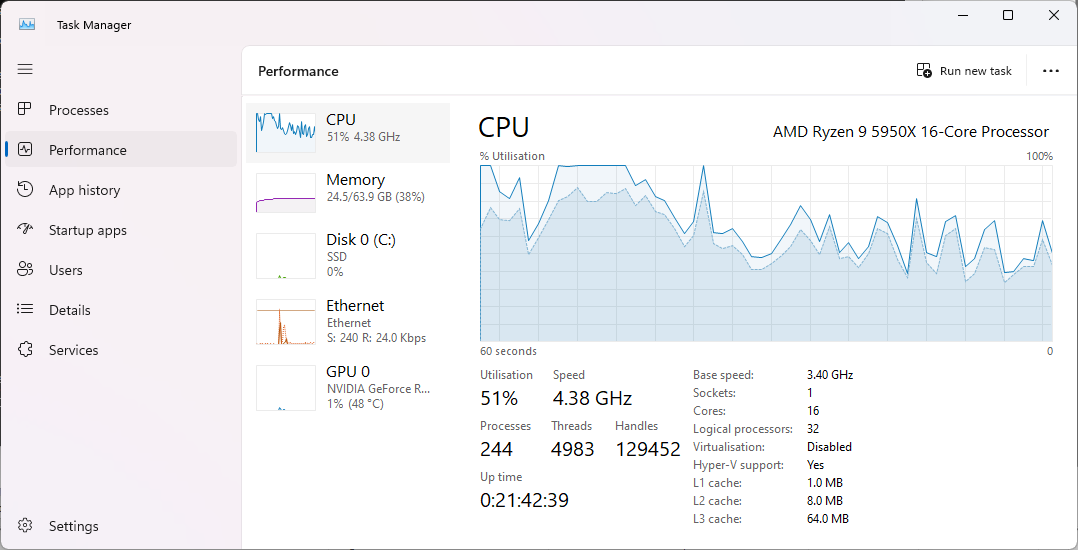
With this PR, most time is spent in user space (light blue):

On higher core count machines, before this PR, the CPU usage becomes
pretty much flat because of contention:
<img width="549" alt="VM_176_windows_heap"
src="https://github.com/llvm/llvm-project/assets/37383324/f27d5800-ee02-496d-a4e7-88177e0727f0">
With this PR, similarily most CPU time is now used:
<img width="549" alt="VM_176_with_rpmalloc"
src="https://github.com/llvm/llvm-project/assets/37383324/7d4785dd-94a7-4f06-9b16-aaa4e2e505c8">
### Changes in this PR
The avenue I've taken here is to vendor/re-licence rpmalloc in-tree, and
use it when building the Windows 64-bit release. Given the permissive
rpmalloc licence, prior discussions with the LLVM foundation and
@lattner suggested this vendoring. Rpmalloc's author (@mjansson) kindly
agreed to ~~donate~~ re-licence the rpmalloc code in LLVM (please do
correct me if I misinterpreted our past communications).
I've chosen rpmalloc because it's small and gives the best value
overall. The source code is only 4 .c files. Rpmalloc is statically
replacing the weak CRT alloc symbols at link time, and has no dynamic
patching like mimalloc. As an alternative, there were several
unsuccessfull attempts made by Russell Gallop to use SCUDO in the past,
please see thread in https://reviews.llvm.org/D86694. If later someone
comes up with a PR of similar performance that uses SCUDO, we could then
delete this vendored rpmalloc folder.
I've added a new cmake flag `LLVM_ENABLE_RPMALLOC` which essentialy sets
`LLVM_INTEGRATED_CRT_ALLOC` to the in-tree rpmalloc source.
### Performance
The most obvious test is profling a ThinLTO linking step with LLD. I've
used a Clang compilation as a testbed, ie.
```
set OPTS=/GS- /D_ITERATOR_DEBUG_LEVEL=0 -Xclang -O3 -fstrict-aliasing -march=native -flto=thin -fwhole-program-vtables -fuse-ld=lld
cmake -G Ninja %ROOT%/llvm -DCMAKE_BUILD_TYPE=Release -DLLVM_ENABLE_ASSERTIONS=TRUE -DLLVM_ENABLE_PROJECTS="clang" -DLLVM_ENABLE_PDB=ON -DLLVM_OPTIMIZED_TABLEGEN=ON -DCMAKE_C_COMPILER=clang-cl.exe -DCMAKE_CXX_COMPILER=clang-cl.exe -DCMAKE_LINKER=lld-link.exe -DLLVM_ENABLE_LLD=ON -DCMAKE_CXX_FLAGS="%OPTS%" -DCMAKE_C_FLAGS="%OPTS%" -DLLVM_ENABLE_LTO=THIN
```
I've profiled the linking step with no LTO cache, with Powershell, such
as:
```
Measure-Command { lld-link /nologo @CMakeFiles\clang.rsp /out:bin\clang.exe /implib:lib\clang.lib /pdb:bin\clang.pdb /version:0.0 /machine:x64 /STACK:10000000 /DEBUG /OPT:REF /OPT:ICF /INCREMENTAL:NO /subsystem:console /MANIFEST:EMBED,ID=1 }`
```
Timings:
| Machine | Allocator | Time to link |
|--------|--------|--------|
| 16c/32t AMD Ryzen 9 5950X | Windows Heap | 10 min 38 sec |
| | **Rpmalloc** | **4 min 11 sec** |
| 32c/64t AMD Ryzen Threadripper PRO 3975WX | Windows Heap | 23 min 29
sec |
| | **Rpmalloc** | **2 min 11 sec** |
| | **Rpmalloc + /threads:64** | **1 min 50 sec** |
| 176 vCPU (2 socket) Intel Xeon Platinium 8481C (fixed clock 2.7 GHz) |
Windows Heap | 43 min 40 sec |
| | **Rpmalloc** | **1 min 45 sec** |
This also improves the overall performance when building with clang-cl.
I've profiled a regular compilation of clang itself, ie:
```
set OPTS=/GS- /D_ITERATOR_DEBUG_LEVEL=0 /arch:AVX -fuse-ld=lld
cmake -G Ninja %ROOT%/llvm -DCMAKE_BUILD_TYPE=Release -DLLVM_ENABLE_ASSERTIONS=TRUE -DLLVM_ENABLE_PROJECTS="clang;lld" -DLLVM_ENABLE_PDB=ON -DLLVM_OPTIMIZED_TABLEGEN=ON -DCMAKE_C_COMPILER=clang-cl.exe -DCMAKE_CXX_COMPILER=clang-cl.exe -DCMAKE_LINKER=lld-link.exe -DLLVM_ENABLE_LLD=ON -DCMAKE_CXX_FLAGS="%OPTS%" -DCMAKE_C_FLAGS="%OPTS%"
```
This saves approx. 30 sec when building on the Threadripper PRO 3975WX:
```
(default Windows Heap)
C:\src\git\llvm-project>hyperfine -r 5 -p "make_llvm.bat stage1_test2" "ninja clang -C stage1_test2"
Benchmark 1: ninja clang -C stage1_test2
Time (mean ± σ): 392.716 s ± 3.830 s [User: 17734.025 s, System: 1078.674 s]
Range (min … max): 390.127 s … 399.449 s 5 runs
(rpmalloc)
C:\src\git\llvm-project>hyperfine -r 5 -p "make_llvm.bat stage1_test2" "ninja clang -C stage1_test2"
Benchmark 1: ninja clang -C stage1_test2
Time (mean ± σ): 360.824 s ± 1.162 s [User: 15148.637 s, System: 905.175 s]
Range (min … max): 359.208 s … 362.288 s 5 runs
```
