Follow-up to #69295: In `Writer<ELFT>::run`, the symbol passes are
flexible:
they can be placed almost everywhere before `scanRelocations`, with a
constraint
that the `computeIsPreemptible` pass must be invoked for linker-defined
non-local symbols.

Merge copyLocalSymbols and demoteLocalSymbolsInDiscardedSections to
simplify
code:

* Demoting local symbols can be made unconditional, not constrainted to
/DISCARD/ uses due to performance concerns
* `includeInSymtab` can be made faster
* Make symbol passes close to each other
* Decrease data cache misses due to saving an iteration over local
symbols

There is no speedup, likely due to the unconditional `dr->section`
access in `demoteAndCopyLocalSymbols`.

`gc-sections-tls.s` no longer reports an error because the TLS symbol is
converted to an Undefined.
When an input section is matched by /DISCARD/ in a linker script, GNU ld
reports errors for relocations referencing symbols defined in the section:
`.aaa' referenced in section `.bbb' of a.o: defined in discarded section `.aaa' of a.o
Implement the error by demoting eligible symbols to `Undefined` and changing
STB_WEAK to STB_GLOBAL. As a side benefit, in relocatable links, relocations
referencing symbols defined relative to /DISCARD/ discarded sections no longer
set symbol/type to zeros.
It's arguable whether a weak reference to a discarded symbol should lead to
errors. GNU ld reports an error and our demoting approach reports an error as
well.
Close#58891
Co-authored-by: Bevin Hansson <bevin.hansson@ericsson.com>
V3 has been deprecated for a while as well, so it can safely be removed
like V2 was removed.

- [Clang] Set minimum code object version to 4
- [lld] Fix tests using code object v3
- Remove code object V3 from the AMDGPU backend, and delete or port v3
tests to v4.
- Update docs to make it clear V3 can no longer be emitted.
CDSort function reordering outperforms the existing default heuristic (
hfsort/C^3) in terms of the performance of generated binaries while
being (almost) as fast. Thus, the suggestion is to change the default.
The speedup is up to 1.5% perf for large front-end binaries, and can be
moderate/neutral for "small" benchmarks.

High-level **perf impact** on two selected binaries:
clang-10 binary (built with LTO+AutoFDO/CSSPGO): wins on top of C^3 in
[0.3%..0.8%]
rocksDB-8 binary (built with LTO+CSSPGO): wins on top of C^3 in
[0.8%..1.5%]

More detailed measurements on the clang binary is at
[here](https://reviews.llvm.org/D152834#4445042)
Integrating MTE globals on Android revealed a lot of cases where
libraries are built as both archives and DSOs, and they're linked into
fully static and dynamic executables respectively.

MTE globals doesn't work for fully static executables. They need a
dynamic loader to process the special R_AARCH64_RELATIVE relocation
semantics with the encoded offset. Fully static executables that had
out-of-bounds derived symbols (like 'int* foo_end = foo[16]') crash
under MTE globals w/ static executables. So, LLD in its current form
simply errors out when you try and compile a fully static executable
that has a single MTE global variable in it.

It seems like a much better idea to simply have LLD not do the special
work for MTE globals in fully static contexts, and to drop any
unnecessary metadata. This means that you can build archives with MTE
globals and link them into both fully-static and dynamic executables.
Treat this as an alias for the --shared option.

In practice in GNU ld, they aren't exact aliases but there are small
subtle differences in what happens and what doesn't, when they are set,
but those differences are probably not intended by users who might be
using the --dll option (which gets passed by -mdll in the compiler
driver), and the differences are within the area where small details
differ between LLD and GNU ld anyway.
Some large AVR programs (for devices without long jump) may exceed
128KiB, and lld should give explicit errors other than generate wrong
executables silently.
This adds support for generating Chrome-tracing .json profile traces in
the LLD COFF driver.
Also add the necessary time scopes, so that the profile trace shows in
great detail which tasks are executed.
As an example, this is what we see when linking a Unreal Engine
executable:
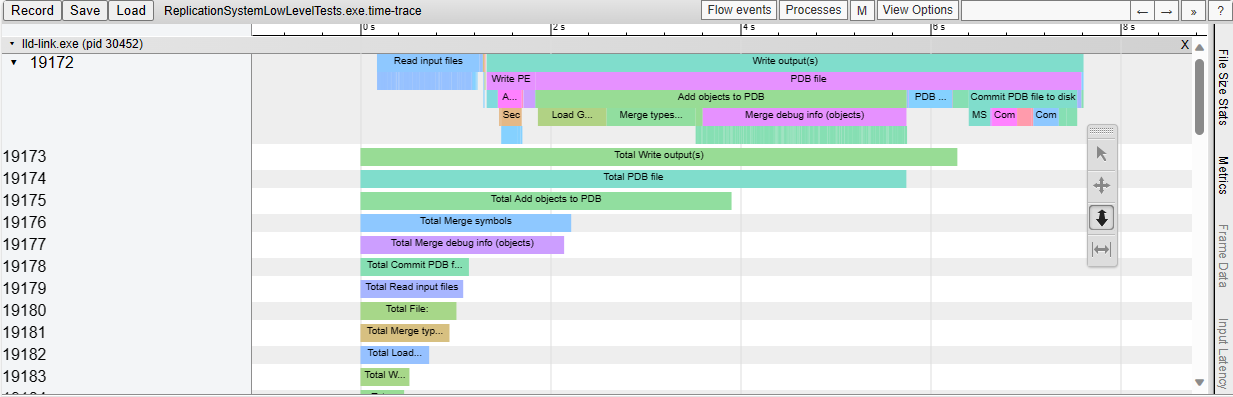
For each R_X86_64_(REX_)GOTPCRELX relocation, check that the offset to the symbol is representable with 2^32 signed offset. If not, add a GOT entry for it and set its expr to R_GOT_PC so that we emit the GOT load instead of the relaxed lea. Do this in finalizeAddressDependentContent() where we iteratively attempt this (e.g. RISCV uses this for relaxation, ARM uses this to insert thunks).

Decided not to do the opposite of inserting GOT entries initially and removing them when relaxable because removing GOT entries isn't simple.

One drawback of this approach is that if we see any GOTPCRELX relocation, we'll create an empty .got even if it's not required in the end.

Reviewed By: MaskRay

Differential Revision: https://reviews.llvm.org/D157020
This can happen when manually emitting strings into .drectve sections
with `__attribute__((section(".drectve")))`, which is a way to emulate
`#pragma comment(linker, "...")` for mingw compilers, without requiring
building with -fms-extensions.
Normally, this doesn't generate any comdat, but if compiled with
-fsanitize=address, this section does get turned into a comdat section.
This fixes#67261. This issue can be seen as a regression; a change in
the "lli" tool in 17.x triggers this case, if compiled with ASAN
enabled, triggering this unsupported corner case in LLD. With this
change, LLD can handle it.
Fixes a crash in `-Wl,-emit-relocs` where the linker was not able to
write linker-synthetic absolute symbols to the symbol table.

This change adds a new symbol flag (`WASM_SYMBOL_ABS`), which means that
the symbol's offset is absolute and not relative to a given segment.
Such symbols include `__stack_low` and `__stack_low`.

Note that wasm object files never contains such symbols, only binaries
linked with `-Wl,-emit-relocs`.

Fixes: #67111
When the .eh_frame section is placed at a non-zero
offset within its output section, the relocation
value within .eh_frame are computed incorrectly.

We had similar issue in .ARM.exidx section and it has been
fixed already in https://reviews.llvm.org/D148033.

While applying the relocation using S+A-P,  the value
 of P (the location of the relocation) is getting wrong.
P is:
  P = SecAddr + rel.offset, But SecAddr points to the
starting address of the outputsection rather than the
starting address of the eh frame section within that
output section.

This issue affects all targets which generates .eh_frame
section. Hence fixing in all the corresponding targets it affecting.
Before af744f0b84e2b6410be65277068b9033124c73b2, the first entry
among the search paths was the empty string, indicating searching
in (or starting from) the current directory. After
af744f0b84e2b6410be65277068b9033124c73b2, the toolchain/clang
specific lib directories were added at the head of the search path.
This would cause lookups of literal file names or relative paths
to match paths in the toolchain, if there are coincidental files
with similar names there, even if they would be find in the current
directory as well.
Change addClangLibSearchPaths to append to the list like all other
operations on searchPaths - but move the invocation of the
function to the right place in the sequence.
This fixes#67779.
We are brining a new algorithm for function layout (reordering) based on the
call graph (extracted from a profile data). The algorithm is an improvement of
top of a known heuristic, C^3. It tries to co-locate hot and frequently executed
together functions in the resulting ordering. Unlike C^3, it explores a larger
search space and have an objective closely tied to the performance of
instruction and i-TLB caches. Hence, the name CDS = Cache-Directed Sort.
The algorithm can be used at the linking or post-linking (e.g., BOLT) stage.
Refer to https://reviews.llvm.org/D152834 for the actual implementation of the
reordering algorithm.

This diff adds a linker option to replace the existing C^3 heuristic with CDS.
The new behavior can be turned on by passing "--use-cache-directed-sort".
(the plan is to make it default in a next diff)

**Perf-impact**
clang-10 binary (built with LTO+AutoFDO/CSSPGO): wins on top of C^3 in [0.3%..0.8%]
rocksDB-8 binary (built with LTO+CSSPGO): wins on top of C^3 in [0.8%..1.5%]

Note that function layout affects the perf the most on older machines (with
smaller instruction/iTLB caches) and when huge pages are not enabled. The impact
on newer processors with huge pages enabled is likely neutral/minor.

Reviewed By: MaskRay

Differential Revision: https://reviews.llvm.org/D152840
Change the FF form --call-graph-profile-sort to --call-graph-profile-sort={none,hfsort}.
This will be extended to support llvm/lib/Transforms/Utils/CodeLayout.cpp.

--call-graph-profile-sort is not used in the wild but
--no-call-graph-profile-sort is (Chromium). Make --no-call-graph-profile-sort an
alias for --call-graph-profile-sort=none.

Reviewed By: rahmanl

Differential Revision: https://reviews.llvm.org/D159544
Code Object V2 has been deprecated for more than a year now. We can
safely remove it from LLVM.

- [clang] Remove support for the `-mcode-object-version=2` option.
- [lld] Remove/refactor tests that were still using COV2
- [llvm] Update AMDGPUUsage.rst
- Code Object V2 docs are left for informational purposes because those
code objects may still be supported by the runtime/loaders for a while.
- [AMDGPU] Remove COV2 emission capabilities.
- [AMDGPU] Remove `MetadataStreamerYamlV2` which was only used by COV2
- [AMDGPU] Update all tests that were still using COV2 - They are either
deleted or ported directly to code object v4 (as v3 is also planned to
be removed soon).
https://reviews.llvm.org/D48929 updated addends for non-SHF_ALLOC sections
relocated by REL for -r links, but the patch did not update the addends when
--compress-debug-sections={zlib,zstd} is used (#66738).
https://reviews.llvm.org/D116946 handled tombstone values in debug
sections in relocatable links. As a side effect, both
relocateNonAllocForRelocatable (using `sec->relocations`) and
relocatenonNonAlloc (using raw REL/RELA) may run.
Actually, we can adjust the condition in relocatenonAlloc to completely replace
relocateNonAllocForRelocatable. This patch implements this idea and fixes#66738.
As relocateNonAlloc processes the raw relocations like copyRelocations() does,
the condition `if (config->relocatable && type != target.noneRel)` in `copyRelocations`
(commit 08d6a3f1337238a480225d4caf71b8fec10dc8c6, modified by https://reviews.llvm.org/D62052)
can be made specific to SHF_ALLOC sections.
As a side effect, we can now report diagnostics for PC-relative relocations for
-r. This is a less useful diagnostic that is not worth too much code. As
https://github.com/ClangBuiltLinux/linux/issues/1937 has violations, just
suppress the warning for -r. Tested by commit 561b98f9e025363b416f4e89af750d01d1e8c4cc.
The size of .ARM.exidx may shrink across `assignAddress` calls. It is
possible
that the initial iteration has a larger location counter, causing
`__code_size =
__code_end - .; osec : { . += __code_size; }` to report an error, while
the error would
have been suppressed for subsequent `assignAddress` iterations.
Other sections like .relr.dyn may change sizes across `assignAddress`
calls as
well. However, their initial size is zero, so it is difficiult to
trigger a
similar error.
Similar to https://reviews.llvm.org/D152170, postpone the error
reporting.
Fix#66836. While here, add more information to the error message.
The `cp` command will copy the permission bits from the original file to
the new one, which will cause permission denied (no written access) for the
following "echo" command in some system.

Switch to use `cat` which is more robust.
Discussion about this approach: https://discourse.llvm.org/t/rfc-safer-whole-program-class-hierarchy-analysis/65144/18

When enabling WPD in an environment where native binaries are present, types we want to optimize can be derived from inside these native files and devirtualizing them can lead to correctness issues. RTTI can be used as a way to determine all such types in native files and exclude them from WPD providing a safe checked way to enable WPD.

The approach is:
1. In the linker, identify if RTTI is available for all native types. If not, under `--lto-validate-all-vtables-have-type-infos` `--lto-whole-program-visibility` is automatically disabled. This is done by examining all .symtab symbols in object files and .dynsym symbols in DSOs for vtable (_ZTV) and typeinfo (_ZTI) symbols and ensuring there's always a match for every vtable symbol.
2. During thinlink, if `--lto-validate-all-vtables-have-type-infos` is set and RTTI is available for all native types, identify all typename (_ZTS) symbols via their corresponding typeinfo (_ZTI) symbols that are used natively or outside of our summary and exclude them from WPD.

Testing:
ninja check-all
large Meta service that uses boost, glog and libstdc++.so runs successfully with WPD via --lto-whole-program-visibility. Previously, native types in boost caused incorrect devirtualization that led to crashes.

Reviewed By: MaskRay, tejohnson

Differential Revision: https://reviews.llvm.org/D155659
.plt and .branch_lt have the type of SHT_NOBITS and may be relocated by dynamic
relocations with non-zero addends. They should be skipped for the
--check-dynamic-relocations check, as --apply-dynamic-relocs does not apply.

A side effect is that -z rel does not work for the two sections.

Added two --apply-dynamic-relocs --check-dynamic-relocations tests. Also checked
linking a PPC64 clang.
The import library thunk name suffix uses the stem of the file. We
currently would attempt to trim the suffix by dropping the trailing 4
characters (under the assumption that the output name was `.lib`). This
now uses the `llvm::sys::path` API for computing the stem. This avoids
an assertion failure when the name is less the 4 characters and
assertions are enabled.
Close#57618: currently we align the end of PT_GNU_RELRO to a
common-page-size
boundary, but do not align the end of the associated PT_LOAD. This is
benign
when runtime_page_size >= common-page-size.
However, when runtime_page_size < common-page-size, it is possible that
`alignUp(end(PT_LOAD), page_size) < alignDown(end(PT_GNU_RELRO),
page_size)`.
In this case, rtld's mprotect call for PT_GNU_RELRO will apply to
unmapped
regions and lead to an error, e.g.
```
error while loading shared libraries: cannot apply additional memory protection after relocation: Cannot allocate memory
```
To fix the issue, add a padding section .relro_padding like mold, which
is contained in the PT_GNU_RELRO segment and the associated PT_LOAD
segment. The section also prevents strip from corrupting PT_LOAD program
headers.
.relro_padding has the largest `sortRank` among RELRO sections.
Therefore, it is naturally placed at the end of `PT_GNU_RELRO` segment
in the absence of `PHDRS`/`SECTIONS` commands.
In the presence of `SECTIONS` commands, we place .relro_padding
immediately before a symbol assignment using DATA_SEGMENT_RELRO_END (see
also https://reviews.llvm.org/D124656), if present.
DATA_SEGMENT_RELRO_END is changed to align to max-page-size instead of
common-page-size.
Some edge cases worth mentioning:
* ppc64-toc-addis-nop.s: when PHDRS is present, do not append
.relro_padding
* avoid-empty-program-headers.s: when the only RELRO section is .tbss,
it is not part of PT_LOAD segment, therefore we do not append
.relro_padding.
---
Close#65002: GNU ld from 2.39 onwards aligns the end of PT_GNU_RELRO to
a
max-page-size boundary (https://sourceware.org/PR28824) so that the last
page is
protected even if runtime_page_size > common-page-size.
In my opinion, losing protection for the last page when the runtime page
size is
larger than common-page-size is not really an issue. Double mapping a
page of up
to max-common-page for the protection could cause undesired VM waste.
Internally
we had users complaining about 2MiB max-page-size applying to shared
objects.
Therefore, the end of .relro_padding is padded to a common-page-size
boundary. Users who are really anxious can set common-page-size to match
their runtime page size.
---
17 tests need updating as there are lots of change detectors.
