Line ending policies were changed in the parent, dccebddb3b80. To make
it easier to resolve downstream merge conflicts after line-ending
policies are adjusted this is a separate whitespace-only commit. If you
have merge conflicts as a result, you can simply `git add --renormalize
-u && git merge --continue` or `git add --renormalize -u && git rebase
--continue` - depending on your workflow.
When using bsd sed that ships with macOS on the object files for
comparison, every command would error with

```
sed: RE error: illegal byte sequence
```

This was potentially fixed for an older version in
6c52b02e7d0df765da608d8119ae8a20de142cff but even the commands in the
example there still have this error. You can repro this with any binary:

```
$ sed s/a/b/ /bin/ls >/dev/null
sed: RE error: illegal byte sequence
```

Where LC_CTYPE appears to no longer solve the issue:

```
$ LC_CTYPE=C sed s/a/b/ /bin/ls >/dev/null
sed: RE error: illegal byte sequence
```

But this change with LC_ALL does:

```
$ LC_ALL=C sed s/a/b/ /bin/ls >/dev/null; echo $?
0
```

It seems like the difference here is that if you have LC_ALL set to
something else, LC_CTYPE does not override it. More info:
https://stackoverflow.com/a/23584470/902968
This was obsoleted by Visual Studio providing built-in support for
running clang-format in VS2017.

We haven't shipped it for years (since
10d2195305ac49605f2b7b6a25a4076c31923191), never got it working with
VS2019, and never even tried with VS2022.

It's time to retire the code.
because that doesn't work (results in `LINK : error LNK2001: unresolved
external symbol malloc`).
Based on the title of #91862 it was only intended for use in 64-bit
builds.
This script helps the release managers merge backport PR's.

It does the following things:

* Validate the PR, checks approval, target branch and many other things.
* Rebases the PR
* Checkout the PR locally
* Pushes the PR to the release branch
* Deletes the local branch

I have found the script very helpful to merge the PR's.
The old version in the llvm/actions repo stopped working after the
version variables were moved out of llvm/CMakeLists.txt. Composite
actions are more simple and don't require javascript, which is why I
reimplemented it as a composite action.

This will fix the failing abi checks on the release branch.
This patch adds support in the bump-version script for bumping the
version of the mlgo-utils package. This should hopefully streamline the
processor for that with the rest of the project and prevent having to
manually update this package individually.
### Context
We have a longstanding performance issue on Windows, where to this day,
the default heap allocator is still lockfull. With the number of cores
increasing, building and using LLVM with the default Windows heap
allocator is sub-optimal. Notably, the ThinLTO link times with LLD are
extremely long, and increase proportionally with the number of cores in
the machine.
In
a6a37a2fcd,
I introduced the ability build LLVM with several popular lock-free
allocators. Downstream users however have to build their own toolchain
with this option, and building an optimal toolchain is a bit tedious and
long. Additionally, LLVM is now integrated into Visual Studio, which
AFAIK re-distributes the vanilla LLVM binaries/installer. The point
being that many users are impacted and might not be aware of this
problem, or are unable to build a more optimal version of the toolchain.
The symptom before this PR is that most of the CPU time goes to the
kernel (darker blue) when linking with ThinLTO:
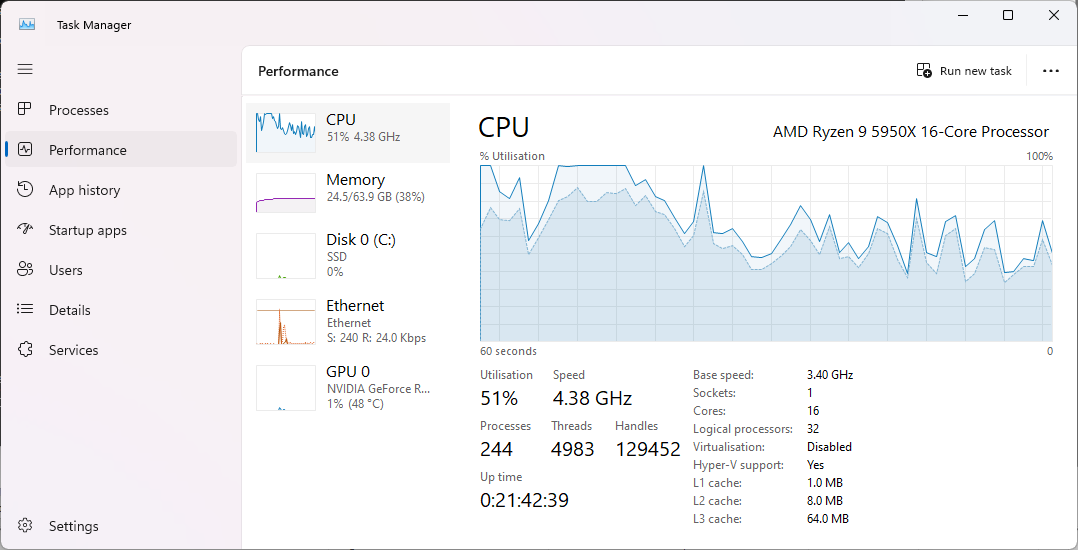
With this PR, most time is spent in user space (light blue):

On higher core count machines, before this PR, the CPU usage becomes
pretty much flat because of contention:
<img width="549" alt="VM_176_windows_heap"
src="https://github.com/llvm/llvm-project/assets/37383324/f27d5800-ee02-496d-a4e7-88177e0727f0">
With this PR, similarily most CPU time is now used:
<img width="549" alt="VM_176_with_rpmalloc"
src="https://github.com/llvm/llvm-project/assets/37383324/7d4785dd-94a7-4f06-9b16-aaa4e2e505c8">
### Changes in this PR
The avenue I've taken here is to vendor/re-licence rpmalloc in-tree, and
use it when building the Windows 64-bit release. Given the permissive
rpmalloc licence, prior discussions with the LLVM foundation and
@lattner suggested this vendoring. Rpmalloc's author (@mjansson) kindly
agreed to ~~donate~~ re-licence the rpmalloc code in LLVM (please do
correct me if I misinterpreted our past communications).
I've chosen rpmalloc because it's small and gives the best value
overall. The source code is only 4 .c files. Rpmalloc is statically
replacing the weak CRT alloc symbols at link time, and has no dynamic
patching like mimalloc. As an alternative, there were several
unsuccessfull attempts made by Russell Gallop to use SCUDO in the past,
please see thread in https://reviews.llvm.org/D86694. If later someone
comes up with a PR of similar performance that uses SCUDO, we could then
delete this vendored rpmalloc folder.
I've added a new cmake flag `LLVM_ENABLE_RPMALLOC` which essentialy sets
`LLVM_INTEGRATED_CRT_ALLOC` to the in-tree rpmalloc source.
### Performance
The most obvious test is profling a ThinLTO linking step with LLD. I've
used a Clang compilation as a testbed, ie.
```
set OPTS=/GS- /D_ITERATOR_DEBUG_LEVEL=0 -Xclang -O3 -fstrict-aliasing -march=native -flto=thin -fwhole-program-vtables -fuse-ld=lld
cmake -G Ninja %ROOT%/llvm -DCMAKE_BUILD_TYPE=Release -DLLVM_ENABLE_ASSERTIONS=TRUE -DLLVM_ENABLE_PROJECTS="clang" -DLLVM_ENABLE_PDB=ON -DLLVM_OPTIMIZED_TABLEGEN=ON -DCMAKE_C_COMPILER=clang-cl.exe -DCMAKE_CXX_COMPILER=clang-cl.exe -DCMAKE_LINKER=lld-link.exe -DLLVM_ENABLE_LLD=ON -DCMAKE_CXX_FLAGS="%OPTS%" -DCMAKE_C_FLAGS="%OPTS%" -DLLVM_ENABLE_LTO=THIN
```
I've profiled the linking step with no LTO cache, with Powershell, such
as:
```
Measure-Command { lld-link /nologo @CMakeFiles\clang.rsp /out:bin\clang.exe /implib:lib\clang.lib /pdb:bin\clang.pdb /version:0.0 /machine:x64 /STACK:10000000 /DEBUG /OPT:REF /OPT:ICF /INCREMENTAL:NO /subsystem:console /MANIFEST:EMBED,ID=1 }`
```
Timings:
| Machine | Allocator | Time to link |
|--------|--------|--------|
| 16c/32t AMD Ryzen 9 5950X | Windows Heap | 10 min 38 sec |
| | **Rpmalloc** | **4 min 11 sec** |
| 32c/64t AMD Ryzen Threadripper PRO 3975WX | Windows Heap | 23 min 29
sec |
| | **Rpmalloc** | **2 min 11 sec** |
| | **Rpmalloc + /threads:64** | **1 min 50 sec** |
| 176 vCPU (2 socket) Intel Xeon Platinium 8481C (fixed clock 2.7 GHz) |
Windows Heap | 43 min 40 sec |
| | **Rpmalloc** | **1 min 45 sec** |
This also improves the overall performance when building with clang-cl.
I've profiled a regular compilation of clang itself, ie:
```
set OPTS=/GS- /D_ITERATOR_DEBUG_LEVEL=0 /arch:AVX -fuse-ld=lld
cmake -G Ninja %ROOT%/llvm -DCMAKE_BUILD_TYPE=Release -DLLVM_ENABLE_ASSERTIONS=TRUE -DLLVM_ENABLE_PROJECTS="clang;lld" -DLLVM_ENABLE_PDB=ON -DLLVM_OPTIMIZED_TABLEGEN=ON -DCMAKE_C_COMPILER=clang-cl.exe -DCMAKE_CXX_COMPILER=clang-cl.exe -DCMAKE_LINKER=lld-link.exe -DLLVM_ENABLE_LLD=ON -DCMAKE_CXX_FLAGS="%OPTS%" -DCMAKE_C_FLAGS="%OPTS%"
```
This saves approx. 30 sec when building on the Threadripper PRO 3975WX:
```
(default Windows Heap)
C:\src\git\llvm-project>hyperfine -r 5 -p "make_llvm.bat stage1_test2" "ninja clang -C stage1_test2"
Benchmark 1: ninja clang -C stage1_test2
Time (mean ± σ): 392.716 s ± 3.830 s [User: 17734.025 s, System: 1078.674 s]
Range (min … max): 390.127 s … 399.449 s 5 runs
(rpmalloc)
C:\src\git\llvm-project>hyperfine -r 5 -p "make_llvm.bat stage1_test2" "ninja clang -C stage1_test2"
Benchmark 1: ninja clang -C stage1_test2
Time (mean ± σ): 360.824 s ± 1.162 s [User: 15148.637 s, System: 905.175 s]
Range (min … max): 359.208 s … 362.288 s 5 runs
```
Before this fix, when building the Windows LLVM package with the latest
cmake 3.29.3 I was seeing:
```
C:\git\llvm-project>llvm\utils\release\build_llvm_release.bat --version 19.0.0 --x64 --skip-checkout --local-python
...
-- Looking for FE_INEXACT
-- Looking for FE_INEXACT - found
-- Performing Test HAVE_BUILTIN_THREAD_POINTER
-- Performing Test HAVE_BUILTIN_THREAD_POINTER - Failed
-- Looking for mach/mach.h
-- Looking for mach/mach.h - not found
-- Looking for CrashReporterClient.h
-- Looking for CrashReporterClient.h - not found
-- Looking for pfm_initialize in pfm
-- Looking for pfm_initialize in pfm - not found
-- Could NOT find ZLIB (missing: ZLIB_LIBRARY ZLIB_INCLUDE_DIR)
CMake Error at C:/Program Files/CMake/share/cmake-3.29/Modules/FindPackageHandleStandardArgs.cmake:230 (message):
  Could NOT find LibXml2 (missing: LIBXML2_INCLUDE_DIR)
Call Stack (most recent call first):
  C:/Program Files/CMake/share/cmake-3.29/Modules/FindPackageHandleStandardArgs.cmake:600 (_FPHSA_FAILURE_MESSAGE)
  C:/Program Files/CMake/share/cmake-3.29/Modules/FindLibXml2.cmake:108 (FIND_PACKAGE_HANDLE_STANDARD_ARGS)
  cmake/config-ix.cmake:167 (find_package)
  CMakeLists.txt:921 (include)


-- Configuring incomplete, errors occurred!
```
It looks like `LIBXML2_INCLUDE_DIRS` (with the extra 'S') is a result
variable that is set by cmake after a call to `find_package(LibXml2)`.
It is actually `LIBXML2_INCLUDE_DIR` (without the 'S') that shold be
used as a input before the `find_package` call, since the 'S' variable
is unconditionally overwritten, see
https://github.com/Kitware/CMake/blob/master/Modules/FindLibXml2.cmake#L96.
I am unsure exactly why that worked with older cmake versions.
After aa02002491333c42060373bc84f1ff5d2c76b4ce we started passing the
user name to the create_release function and this was being interpreted
as the git tag.
Like linux releases, export a tar.xz files containing most llvm tools,
including non toolchain utilities, llvm-config, llvm-link and others.
We do this by reconfiguring cmake one last time at the last step,
running the install target so we do not need to recompile anything.
Fix#51192Fix#53052
The default GitHub token does not have read permissions on the org, so
we need to use a custom token in order to read the members of the
llvm-release-managers team.
As described in [test-release.sh ninja install does builds in Phase
3](https://github.com/llvm/llvm-project/issues/80999), considerable
parts of Phase 3 of a `test-release.sh` build are run by `ninja
install`, ignoring both `$Verbose` and the parallelism set via `-j NUM`.

This patches fixes this by not specifying any explicit build target for
Phase 3, thus running the full build as usual.

Tested on `sparc64-unknown-linux-gnu`.
The current test-release.sh script does not install the necessary
compiler-rt builtin's during Phase 1 on AIX, resulting on a
non-functional Phase 1 clang. Futhermore, the installation is also
necessary for Phase 2 on AIX.

Co-authored-by: Alison Zhang <alisonzhang@ibm.com>
* Split out the lit release job and the documentation build job into
their own workflow files. This makes it possible to manually run these
jobs via workflow_dispatch.

* Improve tag/user validation and ensure it gets run for each release
task.
Add two new flags to the release script:
  `--skip-checkout` builds from the local source folder, instead of the downloaded source package
  `--local-python` uses whichever local Python version is installed, instead of a specific version (3.10)

If the LLVM source is already in `C:\git\llvm-project` then one can do in a admin prompt:
```
C:\git>llvm-project\llvm\utils\release\build_llvm_release.bat --version 18.0.0 --x64 --skip-checkout
...
```
This allows for iterating more easily on build issues, just before a new LLVM package is made.

Also fix some warnings on the second stage build (`-Wbackend-plugin`).
You can now pass the -use-cmake-cache option to test-release.sh and it
will use a predefined cache file for building the release. This will
make it easier to reproduce the builds and add other enhancements like
PGO or bolt optimizations.

---------

Co-authored-by: Konrad Kleine <konrad.kleine@posteo.de>
Compiler-rt built-ins are needed to have a functional Phase 1 clang
compiler on AIX. This PR adds compiler-rt to the runtime_list during Phase 1 to avoid
this problem.

---------

Co-authored-by: Alison Zhang <alisonzhang@ibm.com>
Doxygen documentation takes very long to build, when making releases we
want to get the normal documentation up earlier so that we don't have to
wait for doxygen documentation.

This PR just adds the flag to disable doxygen builds, I will then later
make a PR that changes the actions to first build the normal docs and
another job to build the doxygen docs.
While doing a test-release.sh run on FreeBSD, I ran into a sed error due
to the introduction of the GNU extension '\s' in commit 500587e23dfd.

Scanning for blanks (spaces and tabs) could be done in a more portable
fashion using the [[:blank:]] character class. But it is easier to avoid
the original problem, which is that the projects and runtime lists have
to be separated by semicolons, and cannot start with a semicolon.

Instead, use the shell's alternate value parameter expansion mechanism,
which makes it easy to append items to lists with separators in between,
and without any leading separator. This also avoids having to run sed on
the end result.

In addition, build any selected runtimes in the second phase, otherwise
the third phase can fail to find several symbols in compiler-rt, if that
has been built. This is because the host's compiler-rt is not guaranteed
to have those symbols.

Reviewed By: tstellar

Differential Revision: https://reviews.llvm.org/D145884
`test-release.sh` is too silent in some cases:

- Only the build proper is run verbosely, but `check-all` is not.
- `lit` is run without `-v`, so in case of failures one cannot see what's
actually wrong.

This patch fixes both issues, running all `${MAKE}` invocations with
`$Verbose` (except for `${MAKE} install` where it would only add noise),
and running `lit` with `-v`.

Tested on `x86_64-pc-linux-gnu` and `arm64-apple-darwin21.6`.

Differential Revision: https://reviews.llvm.org/D143249
The stage1 and stage2 builds aren't packaged, so we only need to build
enough of the toolchain to build the next phase.

Reviewed By: thieta, amyk

Differential Revision: https://reviews.llvm.org/D141552
MLIR supports standalone builds, so I think it makes sense to also
produce a release tarball for the MLIR subproject.

Differential Revision: https://reviews.llvm.org/D141919
* Generate `//:vars.bzl` from `llvm/CMakeLists.txt`

`_extract_cmake_settings()` generates `//:vars.bzl` in `llvm_configure()`.
It would be easier to use external commands like sed(1) and python.
For portability, I think the parser should run on Starlark.

`@llvm-project//:vars.bzl` may be loaded from both WORKSPACE and BUILD.
At the moment, `vars.bzl` provides some values as string.

- CMAKE_CXX_STANDARD = "17"
- LLVM_VERSION_MAJOR = "16"
- LLVM_VERSION_MINOR = "0"
- LLVM_VERSION_PATCH = "0"
- LLVM_VERSION = "16.0.0"
- llvm_vars = (dict of these values)

`CMAKE_CXX_STANDARD` may be used to configure toolchain.

* Use `//vars.bzl` for each BUILD files

It would be smarter if the BUILD phase could generate `llvm-config.h`.
Since I am afraid of the discussion in D126581, I just remove
LLVM_VERSION stuff out of the static `llvm-config.h`.

* Eliminate Bazel stuff in 'bump-version.py'

Current version of `bump-version.py` tries to substitute CLANG_VERSION.
It is the reason why I modify bump-version in this change rather than
incoming patch.

Differential Revision: https://reviews.llvm.org/D136392
Unlike projects, runtimes doesn't have a default set of names.
This means you get a leading space at the start, which gets converted
to a ';' giving ";<runtime name>;<runtime name>".

CMake then errors because the "" before the first ';' is treated
as a runtime name and of course it's not a valid name.

Fix this by removing the leading spaces from runtimes before we
insert the ';'.

Reviewed By: ldionne

Differential Revision: https://reviews.llvm.org/D139306
420d7ccbac0f499a6ff9595bdbfa99cd3376df22 introduced BACKEND_PACKAGE_STRING to
replace `PACKAGE_VERSION` (llvm/Config/config.h) to support standalone builds.
This is used in the output of `clang -cc1 -v`.

Since llvm-config.h is available for both standalone and non-standalone builds,
we can just use `LLVM_VERSION_STRING` from llvm-config.h.

clang/cmake/modules/AddClang.cmake uses `VERSION_STRING "${CLANG_VERSION} (${BACKEND_PACKAGE_STRING})"`.
Just simplify it to `"${CLANG_VERSION}"` so that we can remove the CMake
variable BACKEND_PACKAGE_STRING.

Reviewed By: tstellar

Differential Revision: https://reviews.llvm.org/D136660
Instead of hardcoding several VS paths, use vswhere.exe (available from
VS 2017) to get latest version available.

Reviewed By: hans, thieta

Differential Revision: https://reviews.llvm.org/D135873
Options:
--version: [required] version to build
--help: display this help
--x86: build and test x86 variant
--x64: build and test x64 variant

Note: At least one variant to build is required.

Example: build_llvm_release.bat --version 15.0.0 --x64

Reviewed By: hans, thieta

Differential Revision: https://reviews.llvm.org/D135255
Instead of hardcoding a specific VS install, try sequentially:

- %VSINSTALLDIR% (already set from a vs prompt)
- 2019/Enterprise
- 2019/Professional
- 2019/Community
- 2019/BuildTools

It stops when one is found and set vsdevcmd env var.

Differential revision: https://reviews.llvm.org/D135173
