Commit b963c0b658cc54b370832df4f5a3d63fd69da334 fixed LTO compilation of
cases where one translation unit is calling a function with the
dllimport attribute, and another translation unit provides this function
locally within the same linked module (i.e. not actually dllimported);
see https://github.com/llvm/llvm-project/issues/37453 or
https://bugs.llvm.org/show_bug.cgi?id=38105 for full context.

This was fixed by aliasing their GlobalResolution structs, for the
`__imp_` prefixed and non prefixed symbols.

I believe this fix to be wrong.

This patch reverts that fix, and fixes the same issue differently,
within LLD instead.

The fix assumed that one can treat the `__imp_` prefixed and unprefixed
symbols as equal, referencing SVN r240620
(d766653534e0cff702e42a43b44d3057b6094fea). However that referenced
commit had mistaken how this logic works, which was corrected later in
SVN r240622 (88e0f9206b4dccb56dee931adab08f89ff80525a); those symbols
aren't direct aliases for each other - but if there's a need for the
`__imp_` prefixed one and the other one exists, the `__imp_` prefixed
one is created, as a pointer to the other one.

However this fix only works if both translation units are compiled as
LTO; if the caller is compiled as a regular object file and the callee
is compiled as LTO, the fix fails, as the LTO compilation doesn't know
that the unprefixed symbol is needed.

The only level that knows of the potential relationship between the
`__imp_` prefixed and unprefixed symbol, across regular and bitcode
object files, is LLD itself.

Therefore, revert the original fix from
b963c0b658cc54b370832df4f5a3d63fd69da334, and fix the issue differently
- when concluding that we can fulfill an undefined symbol starting with
`__imp_`, mark the corresponding non prefixed symbol as used in a
regular object for the LTO compilation, to make sure that this non
prefixed symbol exists after the LTO compilation, to let LLD do the
fixup of the local import.

Extend the testcase to test a regular object file calling an LTO object
file, which previously failed.

This change also fixes another issue; an object file can provide both
unprefixed and prefixed versions of the same symbol, like this:

    void importedFunc(void) {
    }
    void (*__imp_importedFunc)(void) = importedFunc;

That allows the function to be called both with and without dllimport
markings. (The concept of automatically resolving a reference to
`__imp_func` to a locally defined `func` only is done in MSVC style
linkers, but not in GNU ld, therefore MinGW mode code often uses this
construct.)

Previously, the aliasing of global resolutions at the LTO level would
trigger a failed assert with "Multiple prevailing defs are not allowed"
for this case, as both `importedFunc` and `__imp_importedFunc` could be
prevailing. Add a case to the existing LLD test case lto-imp-prefix.ll
to test this as well.

This change (together with previous change in
3ab6209a3f93bdbeec8e9b9fcc00a9a4980915ff) completes LLD to work with
mingw-w64-crt files (the base glue code for a mingw-w64 toolchain) built
with LTO.
Normally, this shouldn't happen. It can happen in exceptional
circumstances, if the compiled output of a bitcode object file
references symbols that weren't listed as undefined in the bitcode
object file itself.

This can at least happen in the following cases:
- A custom SEH personality is set via asm()
- Compiler generated calls to builtin helper functions, such as
__chkstk, or __rt_sdiv on arm

Both of these produce undefined references to symbols after compiling to
a regular object file, that aren't visible on the level of the IR object
file.

This is only an issue if the referenced symbols are provided as LTO
objects themselves; loading regular object files after the LTO
compilation works fine.

Custom SEH personalities are rare, but one CRT startup file in mingw-w64
does this. The referenced pesonality function is usually provided via an
import library, but for WinStore targets, a local dummy reimplementation
in C is used, which can be an LTO object.

Generated calls to builtins is very common, but the builtins aren't
usually provided as LTO objects (compiler-rt's builtins explicitly pass
-fno-lto when building), and many of the builtins are provided as raw .S
assembly files, which don't get built as LTO objects anyway, even if
built with -flto.

If hitting this unusual, but possible, situation, error out cleanly with
a clear message rather than crashing.
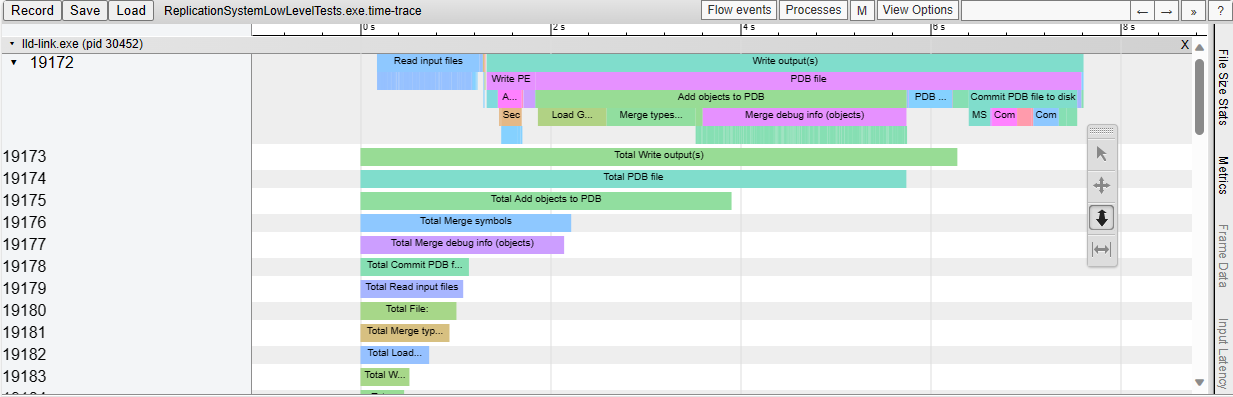
This adds support for generating Chrome-tracing .json profile traces in
the LLD COFF driver.
Also add the necessary time scopes, so that the profile trace shows in
great detail which tasks are executed.
As an example, this is what we see when linking a Unreal Engine
executable:
This reverts commit 7370ff624d217b0f8f7512ca5b651a9b8095a411.
(and 47fb8ae2f9a4075de05433ef24f459b6befd1730).

This commit broke the symbol type in import libraries generated
for mingw autoexported symbols, when the source files were built
with LTO. I'll commit a testcase that showcases this issue after
the revert.
We were previously ignoring weak externals during these searches (which
are used for the entry point, exports, and subsystem inference), which
differed from link.exe behavior. It also meant that we could get
different behavior when linking an object file directly vs. packaging it
into a static library, because static library symbol name directories
include weak externals.

Reviewed By: mstorsjo, yozhu

Differential Revision: https://reviews.llvm.org/D139764
LLVM bitcode contains support for weak symbols, so we can add support
for overriding weak symbols in the output COFF even though COFF doesn't
have inherent support for weak symbols.

The motivation for this patch is that Chromium is trying to use libc++'s
assertion handler mechanism, which relies on weak symbols [0], but we're
unable to perform a ThinLTO build on Windows due to this problem [1].

[0]: https://reviews.llvm.org/D121478
[1]: https://crrev.com/c/3863576

Reviewed By: rnk

Differential Revision: https://reviews.llvm.org/D133165
This relands 73e585e44d (and 0574b5fc657451), with a fix for
the failing test (by using Optional<StringRef>s instead of
making StringRef::empty() mean absence of value).

Differential Revision: https://reviews.llvm.org/D118070
Revert "Reland "[lld/coff] Make lld-link work in a non-MSVC shell, add /winsysroot:""

This reverts commit 0574b5fc657451c9d13d3f6d8fe14ea15c23a681 and 73e585e44d68cf77e2e3274e98c9615156a7d909.

This change is causing the test Driver/cl-options.c to fail on Windows buildbots.
https://lab.llvm.org/staging/#/builders/204/builds/1343
Makes lld-link work in a non-MSVC shell by autodetecting MSVC toolchain. Also
adds support for /winsysroot and a few other switches.

All this is done by refactoring to share code with clang-cl's existing support
for the same.

Differential Revision: https://reviews.llvm.org/D118070
Move all variables at file-scope or function-static-scope into a hosting structure (lld::CommonLinkerContext) that lives at lldMain()-scope. Drivers will inherit from this structure and add their own global state, in the same way as for the existing COFFLinkerContext.

See discussion in https://lists.llvm.org/pipermail/llvm-dev/2021-June/151184.html

Differential Revision: https://reviews.llvm.org/D108850
Similar to ELF 3a5fb57393c3bc77be9e7afc2ec9d4ec3c9bbf70.

* previously when a LazyObjFile was extracted, a new ObjFile/BitcodeFile was created; now the file is reused, just with `lazy` cleared
* avoid the confusing transfer of `symbols` from LazyObjFile to the new file
* simpler code, smaller executable (5200+ bytes smaller on x86-64)
* make eager parsing feasible (for parallel section/symbol table initialization)

Reviewed By: aganea, rnk

Differential Revision: https://reviews.llvm.org/D116434
lld only needs DIContext.h which it gets through Symbolize.h -> SymbolizableModule.h -> DIContext.h. This replaces it with a direct include of DIContext.h to avoid any confusion and pulling in unnecessary headers.

Reviewed By: phosek

Differential Revision: https://reviews.llvm.org/D115659
Original commit description:

  [LLD] Remove global state in lld/COFF

  This patch removes globals from the lldCOFF library, by moving globals
  into a context class (COFFLinkingContext) and passing it around wherever
  it's needed.

  See https://lists.llvm.org/pipermail/llvm-dev/2021-June/151184.html for
  context about removing globals from LLD.

  I also haven't moved the `driver` or `config` variables yet.

  Differential Revision: https://reviews.llvm.org/D109634

This reverts commit a2fd05ada9030eab2258fff25e77a05adccae128.

Original commits were b4fa71eed34d967195514fe9b0a5211fca2bc5bc
and e03c7e367adb8f228332e3c2ef8f45484597b719.
check for timer output"

Seems to be causing a number of asan test failures.

This reverts commit b4fa71eed34d967195514fe9b0a5211fca2bc5bc
and e03c7e367adb8f228332e3c2ef8f45484597b719.
This patch removes globals from the lldCOFF library, by moving globals
into a context class (COFFLinkingContext) and passing it around wherever
it's needed.

See https://lists.llvm.org/pipermail/llvm-dev/2021-June/151184.html for
context about removing globals from LLD.

I also haven't moved the `driver` or `config` variables yet.

Differential Revision: https://reviews.llvm.org/D109634
If linking directly against a DLL without an import library, the
DLL export symbols might not contain stdcall decorations.

If we have an undefined symbol with decoration, and we happen to have
a matching undecorated symbol (which either is lazy and can be loaded,
or already defined), then alias it against that instead.

This matches what's done in reverse, when we have a def file
declaring to export a symbol without decoration, but we only have
a defined decorated symbol. In that case we do a fuzzy match
(SymbolTable::findMangle). This case is more straightforward; if we
have a decorated undefined symbol, just strip the decoration and look
for the corresponding undecorated symbol name.

Add warnings and options for either silencing the warning or disabling
the whole feature, corresponding to how ld.bfd does it.

(This feature works for any symbol decoration mismatch, not only when
linking against a DLL directly; ld.bfd also tolerates it anywhere,
and also fixes up mismatches in the other direction, like
SymbolTable::findMangle, for any symbol, not only exports. But in
practice, at least for lld, it would primarily end up used for linking
against DLLs.)

Differential Revision: https://reviews.llvm.org/D104532
GNU ld.bfd supports linking directly against DLLs without using an
import library, and some projects have picked up on this habit.
(There's no one single unsurmountable issue with using import
libraries, but this is a regularly surfacing missing feature.)

As long as one is linking by name (instead of by ordinal), the DLL
export table contains most of the information needed. (One can
inspect what section a symbol points at, to see if it's a function
or data symbol. The practical implementation of this loops over all
sections for each symbol, but as long as they're not very many, that
should hopefully be tolerable performance wise.)

One exception where the information in the DLL isn't entirely enough
is on i386 with stdcall functions; depending on how they're done,
the exported function name can be a plain undecorated name, while
the import library would contain the full decorated symbol name. This
issue is addressed separately in a different patch.

This is implemented mimicing the structure of a regular import library,
with one InputFile corresponding to the static archive that just adds
lazy symbols, which then are fetched when they are needed. When such
a symbol is fetched, we synthesize a coff_import_header structure
in memory and create a regular ImportFile out of it.

The implementation could be even smaller by just creating ImportFiles
for every symbol available immediately, but that would have the
drawback of actually ending up importing all symbols unless running
with GC enabled (and mingw mode defaults to having it disabled for
historical reasons).

Differential Revision: https://reviews.llvm.org/D104530
Add a simple forwarding option in the MinGW frontend, and implement
the private -wrap option in the COFF linker.

The feature in lld-link isn't gated by the -lldmingw option, but
the option is left as a private, undocumented option primarily
used by the MinGW driver.

The implementation is significantly based on the support for --wrap
in the ELF linker, but many small nuance details are different
between the ELF and COFF linkers, ending up with more than a few
implementation differences.

This fixes https://bugs.llvm.org/show_bug.cgi?id=47384.

Differential Revision: https://reviews.llvm.org/D89004

Reapplied with the bitfield member canInline fixed so it doesn't break
builds targeting windows.
This reverts commit a012c704b5e5b60f9d2a7304d27cbc84a3619571.

Breaks Windows builds.

C:\src\llvm-mint\lld\COFF\Symbols.cpp(26,1): error: static_assert failed due to requirement 'sizeof(lld::coff::SymbolUnion) <= 48' "symbols should be optimized for memory usage"
static_assert(sizeof(SymbolUnion) <= 48,
Add a simple forwarding option in the MinGW frontend, and implement
the private -wrap option in the COFF linker.

The feature in lld-link isn't gated by the -lldmingw option, but
the option is left as a private, undocumented option primarily
used by the MinGW driver.

The implementation is significantly based on the support for --wrap
in the ELF linker, but many small nuance details are different
between the ELF and COFF linkers, ending up with more than a few
implementation differences.

This fixes https://bugs.llvm.org/show_bug.cgi?id=47384.

Differential Revision: https://reviews.llvm.org/D89004
This should fix cases when e.g. auto import is enabled without
mingw mode in total being enabled.

Differential Revision: https://reviews.llvm.org/D89006
The "undefined symbol" error message from lld-link displays up to 3 references to that symbol, and the number of extra references not shown.

This patch removes the computation of the strings for those extra references.

It fixes a freeze of lld-link we accidentally encountered when activating asan on a large project, without linking with the asan library.
In that case, __asan_report_load8 was referenced more than 2 million times, causing the computation of that many display strings, of which only 3 were used.

Differential Revision: https://reviews.llvm.org/D83510
Allow disabling either the full auto import feature, or just
forbidding the cases that require runtime fixups.

As long as all auto imported variables are referenced from separate
.refptr$<name> sections, we can alias them on top of the IAT entries
and don't actually need any runtime fixups via pseudo relocations.
LLVM generates references to variables in .refptr stubs, if it
isn't known that the variable for sure is defined in the same object
module. Runtime pseudo relocs are needed if the addresses of auto
imported variables are used in constant initializers though.

Fixing up runtime pseudo relocations requires the use of
VirtualProtect (which is disallowed in WinStore/UWP apps) or
VirtualProtectFromApp. To allow any risk of ambiguity, allow
rejecting cases that would require this at the linker stage.

This adds support for the --disable-runtime-pseudo-reloc and
--disable-auto-import options in the MinGW driver (matching GNU ld.bfd)
with corresponding lld private options in the COFF driver.

Differential Revision: https://reviews.llvm.org/D78923
Use the unique filenames that are used when /lldsavetemps is passed.
After this change, module names for LTO blobs in PDBs will be unique.
Visual Studio and probably other debuggers expect module names to be
unique.

Revert some changes from 1e0b158db (2017) that are no longer necessary
after removing MSVC LTO support.

Reviewed By: MaskRay

Differential Revision: https://reviews.llvm.org/D78221
As of a while ago, lld groups all undefined references to a single
symbol in a single diagnostic. Back then, I made it so that we
print up to 10 references to each undefined symbol.

Having used this for a while, I never wished there were more
references, but I sometimes found that this can print a lot of
output. lld prints up to 10 diagnostics by default, and if
each has 10 references (which I've seen in practice), and each
undefined symbol produces 2 (possibly very long) lines of output,
that's over 200 lines of error output.

Let's try it with just 3 references for a while and see how
that feels in practice.

Differential Revision: https://reviews.llvm.org/D77017
Both MS link.exe and GNU ld.bfd handle it this way; one can have
multiple object files defining the same absolute symbols, as long
as it defines it to the same value. But if there are multiple absolute
symbols with differing values, it is treated as an error.

Differential Revision: https://reviews.llvm.org/D71981
Previously this caused crashes in the reportDuplicate method.

A DefinedAbsolute doesn't have any InputFile attached to it, so we
can't report the file for the original symbol.

We could add an InputFile argument to SymbolTable::addAbsolute
only for the sake of error reporting, but even then it'd be assymetrical,
only pointing out the file containing the new conflicting definition,
not the original one.

Differential Revision: https://reviews.llvm.org/D71679
This broke in 51dcb292cc002, "[lld-link] diagnose undefined symbols
before LTO when possible" (very soon after the 9.0 branch, so
luckily the 9.0 release is unaffected).

The code for loading objects we believe might be needed for autoimport
(loadMinGWAutomaticImports()) does run before the new
reportUnresolvable() function, but it had a condition to only operate
on symbols from regular object files. This condition came from
resolveRemainingUndefines(), but as loadMinGWAutomaticImports() now
has to operate before the LTO, it has to operate on undefineds from
LTO objects as well.

Differential Revision: https://reviews.llvm.org/D70166
As we now have code that parses the dwarf info for variable locations,
we can use that instead of relying on the higher level Symbolizer library,
reducing the previous two different dwarf codepaths into one.

Differential Revision: https://reviews.llvm.org/D69198

llvm-svn: 375391
This fixes the second part of PR42407.

For files with dwarf debug info, it manually loads and iterates
.debug_info to find the declared location of variables, to allow
reporting them. (This matches the corresponding code in the ELF
linker.)

For functions, it uses the existing getFileLineDwarf which uses
LLVMSymbolizer for translating addresses to file lines.

In object files with codeview debug info, only the source location
of duplicate functions is printed. (And even there, only for the
first input file. The getFileLineCodeView function requires the
object file to be fully loaded and initialized to properly resolve
source locations, but duplicate symbols are reported at a stage when
the second object file isn't fully loaded yet.)

Differential Revision: https://reviews.llvm.org/D68975

llvm-svn: 375218
This makes use of it slightly clearer, and makes it match the
same construct in the lld ELF linker.

Differential Revision: https://reviews.llvm.org/D68935

llvm-svn: 374869
