In LTO, part of LLVM's middle-end runs after linking has finished. LTO's
semantics depend on the complete set of extracted bitcode files being
known at this time. If the middle-end inserts new calls to library
functions (libfuncs) that are implemented in bitcode, this could extract
new bitcode object files into the link. These cannot be compiled,
leading to undefined symbol references.

Additionally, the middle-end in LTO may reason that such library
functions have no references, and it may internalize them, then
manipulate their API or even delete them. Afterwards, it may emit a call
to them, again producing undefined symbol references.

This patch resolves the former issue by ensuring that the middle end
emits no new references to symbols defined in bitcode, and it resolves
the latter issue by ensuring that extracted bitcode for libfuncs is
considered external, since new calls may be emitted to them at any time.

The new semantics are not yet established for MachO LLD, which does not
yet appear to have any special handling for libcalls in LTO. It also
does not yet support distributed ThinLTO; doing so would require
additional (de)serialization work.

This is the patch referenced in @ilovepi's and my talk at the last LLVM
devmeeting: "LT-Uh-Oh"

Gemini 3.1 was used in porting to COFF and WASM LLDs.
The in-process ThinLTO backend typically generates object files in
memory and adds them directly to the link, except when the ThinLTO cache
is in use. DTLTO is unusual in that it adds files to the link from disk
in all cases.

When the ThinLTO cache is not in use, ThinLTO adds files via an
`AddStreamFn` callback provided by the linker, which ultimately appends
to a `SmallVector` in LLD. When the cache is in use, the linker supplies
an `AddBufferFn` callback that adds files more efficiently (by moving
`MemoryBuffer` ownership).

This patch adds a mandatory `AddBufferFn` to the DTLTO ThinLTO backend.
The backend uses this to add files to the link more efficiently.
Additionally:
- Move AddStream from CGThinBackend to InProcessThinBackend, for reader
  clarity.
- Modify linker comments that implied the AddBuffer path is
  cache-specific.

For a Clang link (Debug build with sanitizers and instrumentation) using
an optimized toolchain (PGO non-LTO, llvmorg-22.1.0), measuring the mean
`Add DTLTO files to the link` time trace scope duration:
- On Windows (Windows 11 Pro Build 26200, AMD Family 25 @ ~4.5 GHz, 16
  cores/32 threads, 64 GB RAM), this patch reduces the mean from
  2799.148 ms to 157.972 ms.
- On Linux (Ubuntu 24.04.3 LTS Kernel 6.14, Ryzen 9 5950X, 16
  cores/32 threads, boost up to 5.09 GHz, 64 GB RAM), this patch reduces
  the mean from 255.291 ms to 41.630 ms.

Based on work by @romanova-ekaterina and @kbelochapka.
DTLTO emits temporary files to allow distribution of archive member
inputs.

It also emits temporary files from the ThinLTO backend, such as the
index files needed for each distributed ThinLTO backend compilation.

This change brings archive member temporary files into line with those
produced by the ThinLTO backend. They are now emitted in the same
location, warnings are emitted if they cannot be deleted, and they are
cleaned up on abnormal exit (e.g. Ctrl-C). All temporary files are
preserved when --save-temps is specified.

The existing signal-handling test has been extended to cover the full
set of DTLTO temporary files, and a new test has been added to exercise
temporary file handling in normal operation. Additionally, a minimal
test has been added to show the COFF behaviour.

SIE Internal tracker: TOOLCHAIN-21022
This patch implements support for handling archive members in DTLTO.

Unlike ThinLTO, where archive members are passed as in-memory buffers,
DTLTO requires archive members to be materialized as individual files on
the filesystem.
This is necessary because DTLTO invokes clang externally, which expects
file-based inputs.
To support this, this implementation identifies archive members among
the input files,
saves them to the filesystem, and updates their module_id to match their
file paths.
Add DTLTO linker option `--thinlto-remote-compiler-prepend-arg` to
enable support for the multi-call LLVM driver that requires an
additional option to specify the subcommand, e.g. "llvm clang ...".

Fixes https://github.com/llvm/llvm-project/issues/159125.
In order to better see what's going on during ThinLTO linking, this PR
adds more profile tags when using `--time-trace` on a `lld-link.exe`
invocation.

After PR, linking `clang.exe`:

<img width="3839" height="2026" alt="Capture d’écran 2025-09-02 082021"
src="https://github.com/user-attachments/assets/bf0c85ba-2f85-4bbf-a5c1-800039b56910"
/>

Linking a custom (Unreal Engine game) binary gives a completly
different picture, probably because of using Unity files, and the sheer
amount of input files (here, providing over 60 GB of .OBJs/.LIBs).

<img width="1940" height="1008" alt="Capture d’écran 2025-09-02 102048"
src="https://github.com/user-attachments/assets/60b28630-7995-45ce-9e8c-13f3cb5312e0"
/>
This patch introduces support for Integrated Distributed ThinLTO (DTLTO)
in COFF LLD.

DTLTO enables the distribution of ThinLTO backend compilations via
external distribution systems, such as Incredibuild, during the
traditional link step: https://llvm.org/docs/DTLTO.html.

Note: Bitcode members of non-thin archives are not currently supported.
This will be addressed in a future change. This patch is sufficient to
allow for self-hosting an LLVM build with DTLTO if thin archives are
used.

Testing:
- LLD `lit` test coverage has been added, using a mock distributor to
avoid requiring Clang.
- Cross-project `lit` tests cover integration with Clang.

For the design discussion of the DTLTO feature, see:
https://github.com/llvm/llvm-project/pull/126654
We've noticed that for large builds executing thin-link can take on the
order of 10s of minutes. We are only using a single thread to write the
sharded indices and import files for each input bitcode file. While we
need to ensure the index file produced lists modules in a deterministic
order, that doesn't prevent us from executing the rest of the work in
parallel.

In this change we use a thread pool to execute as much of the backend's
work as possible in parallel. In local testing on a machine with 80
cores, this change makes a thin-link for ~100,000 input files run in ~2
minutes. Without this change it takes upwards of 10 minutes.

---------

Co-authored-by: Nuri Amari <nuriamari@fb.com>
This matches ELF (#97480). clang cc1 -emit-llvm and -emit-llvm-bc for
ThinLTO backend compilation also uses `PreCodeGenModuleHook`.

While here, replace deprecated %T with %t.

Pull Request: https://github.com/llvm/llvm-project/pull/98589
Following the commit of #83972 which added COFF support for SPGO, this
patch ports the support of the option -lto-sample-profile that was only
available in the ELF variant of LLD to the COFF variant to enable
running the SPGO passes in the LTO/thinLTO pipelines.
This adds support for generating Chrome-tracing .json profile traces in
the LLD COFF driver.
Also add the necessary time scopes, so that the profile trace shows in
great detail which tasks are executed.
As an example, this is what we see when linking a Unreal Engine
executable:
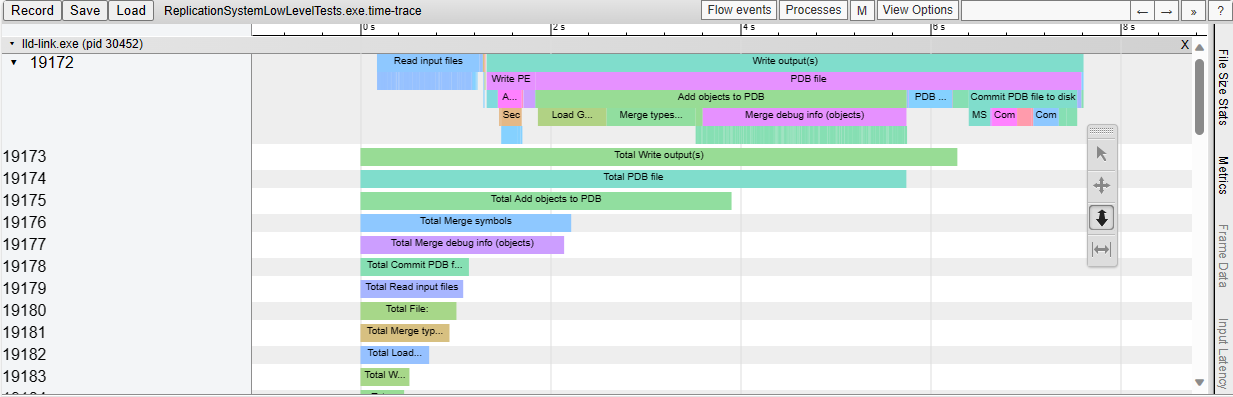
This will make it easy for callers to see issues with and fix up calls
to createTargetMachine after a future change to the params of
TargetMachine.

This matches other nearby enums.

For downstream users, this should be a fairly straightforward
replacement,
e.g. s/CodeGenOpt::Aggressive/CodeGenOptLevel::Aggressive
or s/CGFT_/CodeGenFileType::
This patch added /dwodir to lld/COFF which is equivalent to lld/ELF
option -plugin-opt=dwo_dir=. This option tells LTO backend to create
dwo directory and files and all dwo files will be in it. Otherwise all
dwarf sections will be embeded into image even if -gsplit-dwarf is
specified when using LTO.

Reviewed By: MaskRay

Differential Revision: https://reviews.llvm.org/D154070
Currently, the --thinlto-prefix-replace="oldpath;newpath" option is used during
distributed ThinLTO thin links to specify the mapping of the input bitcode object
files' directory tree (oldpath) to the directory tree (newpath) used for both:

1) the output files of the thin link itself (the .thinlto.bc index files and the
optional .imports files)
2) the specified object file paths written to the response file given in the
--thinlto-index-only=${response} option, which is used by the final native
link and must match the paths of the native object files that will be
produced by ThinLTO backend compiles.
This patch expands the --thinlto-prefix-replace option to allow a separate directory
tree mapping to be specified for the object file paths written to the response file
(number 2 above). This is important to support builds and build systems where the
same output directory may not be written by multiple build actions (e.g. the thin link
and the ThinLTO backend compiles).

The new format is: --thinlto-prefix-replace="origpath;outpath[;objpath]"

This replaces the origpath directory tree of the thin link input files with
outpath when writing the thin link index and imports outputs (number 1
above). If objpath is specified it replaces origpath of the input files with
objpath when writing the response file (number 2 above), otherwise it
falls back to the old behavior of using outpath for this as well.

Reviewed By: tejohnson, MaskRay

Differential Revision: https://reviews.llvm.org/D144596
Allow controlling the CodeGenOpt::Level independent of the LTO
optimization level in LLD via new options for the COFF, ELF, MachO, and
wasm frontends to lld. Most are spelled as --lto-CGO[0-3], but COFF is
spelled as -opt:lldltocgo=[0-3].

See D57422 for discussion surrounding the issue of how to set the CG opt
level. The ultimate goal is to let each function control its CG opt
level, but until then the current default means it is impossible to
specify a CG opt level lower than 2 while using LTO. This option gives
the user a means to control it for as long as it is not handled on a
per-function basis.

Reviewed By: MaskRay, #lld-macho, int3

Differential Revision: https://reviews.llvm.org/D141970
This reverts commit 7370ff624d217b0f8f7512ca5b651a9b8095a411.
(and 47fb8ae2f9a4075de05433ef24f459b6befd1730).

This commit broke the symbol type in import libraries generated
for mingw autoexported symbols, when the source files were built
with LTO. I'll commit a testcase that showcases this issue after
the revert.
Breaks build of LLVMgold here:
```
/repositories/llvm-project/llvm/tools/gold/gold-plugin.cpp:1108:19: error: no matching function for call to 'localCache'
    Cache = check(localCache("ThinLTO", "Thin", options::cache_dir, AddBuffer));
                  ^~~~~~~~~~
/repositories/llvm-project/llvm/include/llvm/Support/Caching.h:72:21: note: candidate function not viable: no known conversion from '(lambda at /repositories/llvm-project/llvm/tools/gold/gold-plugin.cpp:1102:20)' to 'llvm::AddBufferFn' (aka 'function<void (unsigned int, const llvm::Twine &, std::unique_ptr<MemoryBuffer>)>') for 4th argument
Expected<FileCache> localCache(
                    ^
/repositories/llvm-project/llvm/tools/gold/gold-plugin.cpp:1110:18: error: no viable conversion from '(lambda at /repositories/llvm-project/llvm/tools/gold/gold-plugin.cpp:1094:20)' to 'llvm::AddStreamFn' (aka 'function<Expected<std::unique_ptr<CachedFileStream>> (unsigned int, const llvm::Twine &)>')
  check(Lto->run(AddStream, Cache));
                 ^~~~~~~~~
/usr/bin/../lib/gcc/x86_64-linux-gnu/12/../../../../include/c++/12/bits/std_function.h:375:7: note: candidate constructor not viable: no known conversion from '(lambda at /repositories/llvm-project/llvm/tools/gold/gold-plugin.cpp:1094:20)' to 'std::nullptr_t' for 1st argument
      function(nullptr_t) noexcept
      ^
/usr/bin/../lib/gcc/x86_64-linux-gnu/12/../../../../include/c++/12/bits/std_function.h:386:7: note: candidate constructor not viable: no known conversion from '(lambda at /repositories/llvm-project/llvm/tools/gold/gold-plugin.cpp:1094:20)' to 'const std::function<llvm::Expected<std::unique_ptr<llvm::CachedFileStream>> (unsigned int, const llvm::Twine &)> &' for 1st argument
      function(const function& __x)
      ^
/usr/bin/../lib/gcc/x86_64-linux-gnu/12/../../../../include/c++/12/bits/std_function.h:404:7: note: candidate constructor not viable: no known conversion from '(lambda at /repositories/llvm-project/llvm/tools/gold/gold-plugin.cpp:1094:20)' to 'std::function<llvm::Expected<std::unique_ptr<llvm::CachedFileStream>> (unsigned int, const llvm::Twine &)> &&' for 1st argument
      function(function&& __x) noexcept
      ^
/usr/bin/../lib/gcc/x86_64-linux-gnu/12/../../../../include/c++/12/bits/std_function.h:435:2: note: candidate template ignored: requirement '_Callable<(lambda at /repositories/llvm-project/llvm/tools/gold/gold-plugin.cpp:1094:20) &, (lambda at /repositories/llvm-project/llvm/tools/gold/gold-plugin.cpp:1094:20), std::__invoke_result<(lambda at /repositories/llvm-project/llvm/tools/gold/gold-plugin.cpp:1094:20) &, unsigned int, const llvm::Twine &>>::value' was not satisfied [with _Functor = (lambda at /repositories/llvm-project/llvm/tools/gold/gold-plugin.cpp:1094:20) &]
        function(_Functor&& __f)
        ^
/repositories/llvm-project/llvm/include/llvm/LTO/LTO.h:278:25: note: passing argument to parameter 'AddStream' here
  Error run(AddStreamFn AddStream, FileCache Cache = nullptr);
                        ^

```

This reverts commit 387620aa8cea33174b6c1fb80c1af713fee732ac.
Currently the lto native object files have names like main.exe.lto.1.obj. In
PDB, those names are used as names for each compiland. Microsoft’s tool
SizeBench uses those names to present to users the size of each object files.
So, names like main.exe.lto.1.obj is not user friendly.

This patch makes the lto native object file names more readable by using
the bitcode file names as part of the file names. For example, if the input
bitcode file has path like "path/to/foo.obj", its corresponding lto native
object file path would be "path/to/main.exe.lto.foo.obj". Since the lto native
object file name only bothers PDB, this patch only changes the lld-linker's
behavior.

Reviewed By: tejohnson, MaskRay, #lld-macho

Differential Revision: https://reviews.llvm.org/D137217
Like D134013, but for COFF and Mach-O.

Also expand the ELF test a bit. I at first didn't realize that `getValue()` for
`-mllvm -foo=bar` would return `-foo=bar` instead of just `bar`, and so
I wrote the test to check if we indeed get this wrong. We don't, but
having the test for it seems nice, so I'm including it.

Differential Revision: https://reviews.llvm.org/D137971
A specific case for ThinLTO cache pruning is that the current build is huge, and the cache wasn't big enough to hold the intermediate object files of that build. So in doing that build, a file would be cached, and later in that same build it would be evicted. This was significantly decreasing the effectiveness of the cache. By giving this warning, the user could identify the required cache size/files and improve ThinLTO link speed.

Differential Revision: https://reviews.llvm.org/D135590
We should catch more issues this way.

This previously the behavior and was dropped in cde5e5b600b06.

Reviewed By: hans

Differential Revision: https://reviews.llvm.org/D134839
This removes options for performing LTO with the legacy pass
manager in LLD. Options that explicitly enable the new pass manager
are retained as no-ops.

Differential Revision: https://reviews.llvm.org/D123219
Move all variables at file-scope or function-static-scope into a hosting structure (lld::CommonLinkerContext) that lives at lldMain()-scope. Drivers will inherit from this structure and add their own global state, in the same way as for the existing COFFLinkerContext.

See discussion in https://lists.llvm.org/pipermail/llvm-dev/2021-June/151184.html

Differential Revision: https://reviews.llvm.org/D108850
This diff makes several amendments to the local file caching mechanism
which was migrated from ThinLTO to Support in
rGe678c51177102845c93529d457b020f969125373 in response to follow-up
discussion on that commit.

Patch By: noajshu

Differential Revision: https://reviews.llvm.org/D113080
We would like to move ThinLTO’s battle-tested file caching mechanism to
the LLVM Support library so that we can use it elsewhere in LLVM.

Patch By: noajshu

Differential Revision: https://reviews.llvm.org/D111371
We would like to move ThinLTO’s battle-tested file caching mechanism to
the LLVM Support library so that we can use it elsewhere in LLVM.

Patch By: noajshu

Differential Revision: https://reviews.llvm.org/D111371
Original commit description:

  [LLD] Remove global state in lld/COFF

  This patch removes globals from the lldCOFF library, by moving globals
  into a context class (COFFLinkingContext) and passing it around wherever
  it's needed.

  See https://lists.llvm.org/pipermail/llvm-dev/2021-June/151184.html for
  context about removing globals from LLD.

  I also haven't moved the `driver` or `config` variables yet.

  Differential Revision: https://reviews.llvm.org/D109634

This reverts commit a2fd05ada9030eab2258fff25e77a05adccae128.

Original commits were b4fa71eed34d967195514fe9b0a5211fca2bc5bc
and e03c7e367adb8f228332e3c2ef8f45484597b719.
check for timer output"

Seems to be causing a number of asan test failures.

This reverts commit b4fa71eed34d967195514fe9b0a5211fca2bc5bc
and e03c7e367adb8f228332e3c2ef8f45484597b719.
This patch removes globals from the lldCOFF library, by moving globals
into a context class (COFFLinkingContext) and passing it around wherever
it's needed.

See https://lists.llvm.org/pipermail/llvm-dev/2021-June/151184.html for
context about removing globals from LLD.

I also haven't moved the `driver` or `config` variables yet.

Differential Revision: https://reviews.llvm.org/D109634
When enable CSPGO for ThinLTO, there are profile cfg mismatch warnings that will cause lld-link errors (with /WX)
due to source changes (e.g. `#if` code runs for profile generation but not for profile use)
To disable it we have to use an internal "/mllvm:-no-pgo-warn-mismatch" option.
In contrast clang uses option ”-Wno-backend-plugin“ to avoid such warnings and gcc has an explicit "-Wno-coverage-mismatch" option.

Add "lto-pgo-warn-mismatch" option to lld COFF/ELF to help turn on/off the profile mismatch warnings explicitly when build with ThinLTO and CSPGO.

Differential Revision: https://reviews.llvm.org/D104431
