Only platform specific darwin OS values (e.g. macosx, ios, watchos, ...) can be
mapped to an LC_BUILD_VERSION platform. For all other values return an empty
optional to indicate that the load command can't be constructed.

Also fixes the simulator conditions to return the correct platform, and adds a
testcase.
This change implements part 1 of 2 for #70095
- `hlsl_intrinsics.h` - add the `isinf` api
- `Builtins.td` - add an hlsl builtin for `isinf`.
- `CGBuiltin.cpp` add the ir generation for `isinf` intrinsic.
- `SemaChecking.cpp` - add a non-math elementwise checks because this is
a bool return.
- `IntrinsicsDirectX.td` - add an `isinf` intrinsic.

`DXIL.td` lowering is left, but changes need to be made there before we
can support this case.
A downstream overlay mode user ran into issues with the isnan macro not
working in our sources with a specific libc configuration. This patch
replaces the last direct includes of math.h with our internal
math_macros.h, along with the necessary build system changes.
This change implements #70074
- `hlsl_intrinsics.h` - add the `rsqrt` api
- `DXIL.td` add the llvm intrinsic to DXIL op lowering map.
- `Builtins.td` - add an hlsl builtin for rsqrt.
- `CGBuiltin.cpp` add the ir generation for the rsqrt intrinsic.
- `SemaChecking.cpp` - reuse the one arg float only  checks.
- `IntrinsicsDirectX.td` -add an `rsqrt` intrinsic.
For Mach-O, ld64 supports the `-fobjc-relative-method-lists` flag which
changes the format in which method lists are generated. The format uses
delta encoding vs the original direct-pointer encoding.
This change adds support to `llvm-objdump` and `llvm-otool` for
decoding/dumping of method lists in the delta format. Previously, if a
binary with this information format was passed to the tooling, it would
output invalid information, trying to parse the delta lists as pointer
lists.
After this change, the tooling will output correct information if a
binary in this format is encountered.
The output format is closest feasible match to XCode 15.1's otool
output. Tests are included for both 32bit and 64bit binaries.
The code style was matched as close as possible to existing
implementation of parsing non-delta method lists.
Diff between llvm-objdump and XCode 15.1 otool:
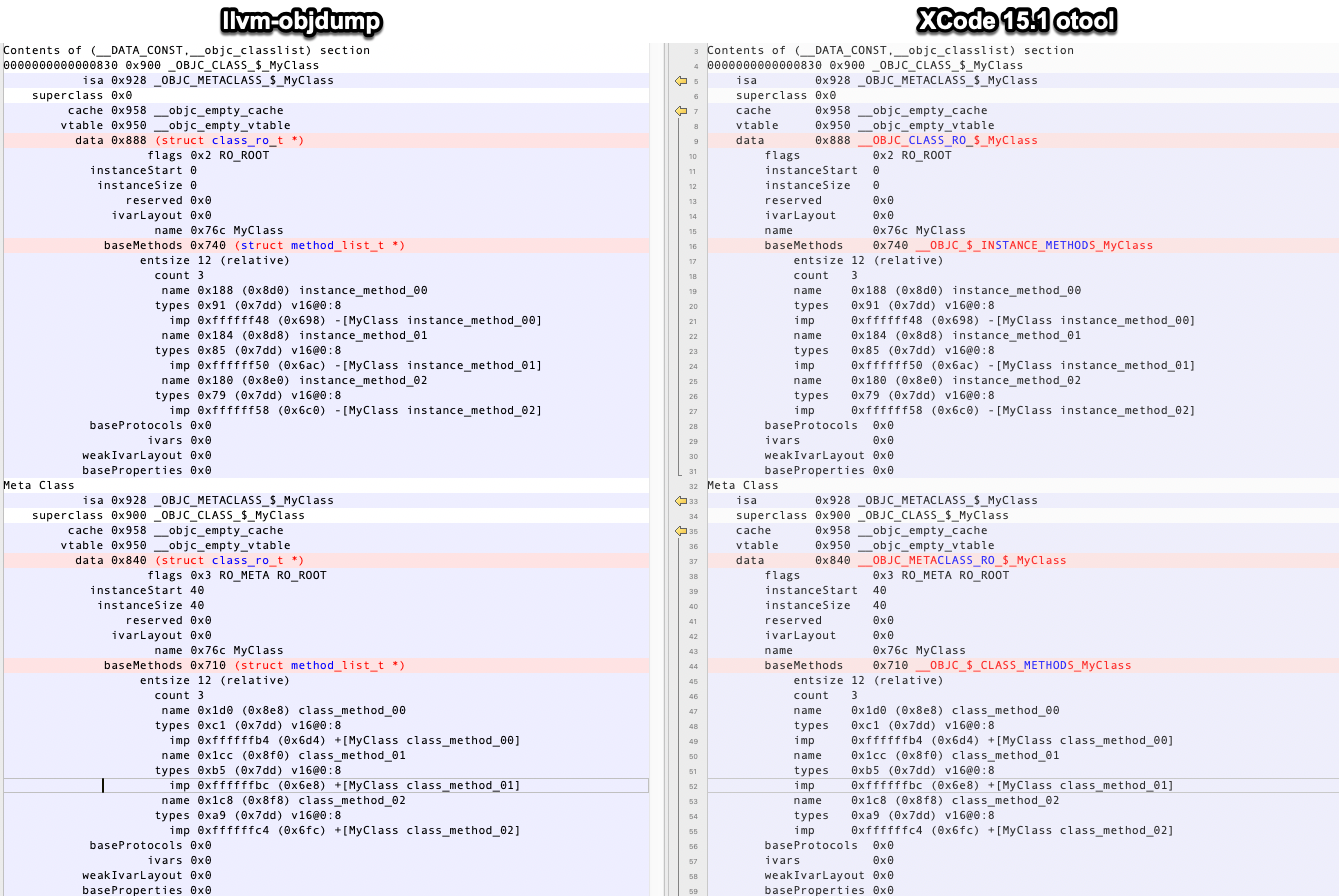
---------
Co-authored-by: Alex B <alexborcan@meta.com>
Switch from `.weak` to `.common` linkage for common global variables
where possible. The `.common` linkage is described in [PTX ISA 11.6.4.
Linking Directives:
.common](https://docs.nvidia.com/cuda/parallel-thread-execution/index.html#linking-directives-common)
> Declares identifier to be globally visible but “common”.
>
>Common symbols are similar to globally visible symbols. However
multiple object files may declare the same common symbol and they may
have different types and sizes and references to a symbol get resolved
against a common symbol with the largest size.
>
>Only one object file can initialize a common symbol and that must have
the largest size among all other definitions of that common symbol from
different object files.
>
>.common linking directive can be used only on variables with .global
storage. It cannot be used on function symbols or on symbols with opaque
type.
The following tests fail when built with Address
and Undefined sanitizers:
CodeGen/PowerPC/basic-toc-data-def.ll
CodeGen/PowerPC/toc-data-large-array2.ll

Subtarget may be null in emitGlobalVariable, for example in the testcase
where we have no functions in the IR. The fix moves this function from
PPCSubtarget to a static helper function. This only fails with
sanitizers because the Subtarget is not used in the member function.
This patch adds support for masked vectorisation of depthwise 1D WC
convolutions,`linalg.depthwise_conv_1d_nwc_wc`. This is implemented by
adding support for masking.

Two major assumptions are made:
  * only the channel dimension can be dynamic/scalable (i.e. the
    trailing dim),
  * when specifying vector sizes to use in the vectoriser, only the size
    corresponding to the channel dim is effectively used (other dims are
    inferred from the context).

In terms of scalable vectorisation, this should be sufficient to cover
all practical cases (i.e. making arbitrary dim scalable wouldn't make
much sense). As for more generic cases with dynamic shapes (e.g. W or N
dims being dynamic), more work would be needed. In particular, one would
have to consider the filter and input/output tensors separately.
Refactor MCPlusBuilder's create{Instruction}() functions that used to
return bool. We almost never check the return value as we rely on
llvm_unreachable() to detect unimplemented functionality. There were a
couple of cases that checked the return value, but they would hit the
unreachable condition first (at least in debug builds) before the return
value gets checked.
The instruction itself can be considered good for minbitwidth casting,
even if one of the operand checks returns false.

Reviewers: RKSimon

Reviewed By: RKSimon

Pull Request: https://github.com/llvm/llvm-project/pull/84363
Avoid referencing executionEnvironment in the device code, since
environment.cpp is not part of the CUDA build yet.
This is a temporary fix before #85182 is merged.
Add a clspv switch in gen_convert.cl
This is needed as Vulkan SPIR-V does not respect the assumptions
needed to have the generic convert.cl compliant on many platforms.

It is needed because of the conversion of TYPE_MAX and
TYPE_MIN. Depending on the platform the behaviour can vary, but most
of them just do not convert correctly those 2 values.

Because of that, we also need to avoid having explicit function for
simple conversions because it allows llvm to optimise the code, thus
removing some of the added checks that are in fact needed.
We can treat a shift by constant as a multiply by a power of 2
and we can treat an or disjoint as a 'add nsw nuw'.

I've added a helper struct similar to a struct used in
ScalarEvolution.cpp
to represent the opcode, operands, and NSW/NUW flags for normal
add/sub/mul
and shl/or that are being treated as mul/add.

I don't think we need to teach cloneIVUser about this. It will continue
to clone them using cloneBitwiseIVUser. After the cloning we will ask
for the SCEV expression for the cloned IV user and verify that it
matches
the AddRec returned by getExtendedOperandRecurrence. Since SCEV also
knows how to convert shl to mul and or disjoint to add nsw nuw, this
should
usually match. If it doesn't match, the cloned IV user will be deleted.
Reset operand list whenever we create a new instruction via a parameter
passed by reference. Most functions were already doing this, but there
are several places missing the reset. Potentially, if we don not clear
the list it could lead to invalid instruction operands. But the existing
code is unaffected.
Removing the extension to FullWidth should make them much more efficient
in the 64-bit case, because 65-bit APInts use a separate allocation for
their bits.
Comparing c_ptr type for equality or inequality is raising an error.

```
not yet implemented: intrinsic module procedure: c_ptr_eq
```
or this one for inequality
```
not yet implemented: intrinsic module procedure: c_ptr_ne
```

This patch adds a lowering for them and fix the `__fortran_builtins.f90`
module for inequality.
…ctive

The function `ActOnOpenMPTargetParallelForSimdDirective` gets the number
of capture levels for OMPD_target_parallel_for, whereas the intended
directive is OMPD_target_parallel_for_simd.
getArithmeticInstrCost is used by both LoopVectorizer and SLPVectorizer
to compute the cost of frem, which becomes a call cost on AArch64 when
TLI has a vector library function.

Add tests that do SLP vectorization for code that contains 2x double and
4x float frem instructions.
Code in plugins-nextgen reading ELF files is currently hard-coded to
assume a 64-bit little-endian ELF format. Unfortunately, this assumption
is even embedded in the interface between GlobalHandler and Utils/ELF
routines, which use ELF64LE types.

To fix this, I've refactored the interface to use generic types, in
particular by using (a unique_ptr to) ObjectFile instead of
ELF64LEObjectFile, and ELFSymbolRef instead of ELF64LE::Sym.

This allows properly templating over multiple ELF format variants inside
Utils/ELF; specifically, this patch adds support for 64-bit big-endian
ELF files in addition to 64-bit little-endian files.
These are Wasm only functions so they are better be within `WebAssembly`
namespace rather than the `llvm` namespace which includes the whole
LLVM.

Also this removes `extern` keywords which are not strictly necessary.
When calling setbuf(nullptr, 0) before performing file operations it
should set the file to unbuffered mode. Currently the code avoids
buffering internally, but the underlying stream still can buffer.

This is addressed by disabling the buffering of the underlying stream.

Fixes: https://github.com/llvm/llvm-project/issues/60509
This reverts commit bbc0f99f3bc96f1db16f649fc21dd18e5b0918f6
(https://reviews.llvm.org/D157663).

With this change, `-g` for the next major release 19.1 will generate
R_RISCV_SET_ULEB128/R_RISCV_SUB_ULEB128 relocations, which require
lld>=18 or binutils>=2.41.
binutils 2.41 is relatively new, but GCC has been producing
R_RISCV_SET_ULEB128/R_RISCV_SUB_ULEB128 for some time now.
#69295 demoted Defined symbols relative to discarded sections.
If such a symbol is unreferenced, the desired behavior is to
eliminate it from .symtab just like --gc-sections discarded
definitions.
Linux kernel's CONFIG_DEBUG_FORCE_WEAK_PER_CPU=y configuration expects
that the unreferenced `unused` is not emitted to .symtab
(https://github.com/ClangBuiltLinux/linux/issues/2006).
For relocations referencing demoted symbols, the symbol index restores
to 0 like older lld (`R_X86_64_64 0` in `discard-section.s`).
Fix#85048
Some languages may create artificial functions that have no real user
code, even though there is line table information for them. One such
case is with coroutine code that receives the CoroSplitter
transformation in LLVM IR. That code transformation creates many
different Functions, cloning one Instruction into many Instructions in
many different Functions and copying the associated debug locations.

It would be difficult to make that pass delete debug locations of cloned
instructions in a language agnostic way (is it even possible?), but LLDB
can ignore certain locations by querying its Language APIs and having it
decide based on, for example, mangling information.
In file included from ../llvm-project/flang/lib/Lower/OpenMP/Clauses.cpp:9:
../llvm-project/flang/lib/Lower/OpenMP/Clauses.h:195:17: error: suggest braces around initialization of subobject [-Werror,-Wmissing-braces]
  195 |   return Clause{id, specific, source};
      |                 ^~~~~~~~~~~~
      |                 {           }
Darwin AArch64 application processors are run with Top Byte Ignore mode
enabled so metadata may be stored in the top byte, it needs to be
ignored when reading/writing memory. David Spickett handled this already
in the base class Process::ReadMemory but ProcessMachCore overrides that
method (to avoid the memory cache) and did not pick up the same change.
I add a test case that creates a pointer with metadata in the top byte
and dereferences it with a live process and with a corefile.

rdar://123784501
The depths of the Root and the NewRoot are to be compared in
MachineCombiner::improvesCriticalPathLen(), and while the call to
BlockTrace.getInstrCycles(*Root) includes the Depth of a PHI, for some
reason PHI nodes have been ignored in getOperandDef().

This patch removes the special handling of PHIs in getOperandDef() so that
Root and NewRoot get a fair comparison. This does not affect loop headers
as MachineTraceMetrics handles that case by ignoring incoming PHI edges.
